Data Observability: Ensuring Healthy Data Pipelines
In today's data-driven world, organizations rely heavily on data for critical decisions, operational efficiency, and customer insights. But what happens when the data itself is unreliable, incomplete, or arrives too late? Just as software applications need to be monitored for performance and errors, the data flowing through an organization's systems also needs constant attention. This is where Data Observability comes in.
What is Data Observability?
At its core, Data Observability is the ability to understand the health, quality, and reliability of data across its entire lifecycle, from ingestion to consumption. It's about gaining full visibility into your data pipelines and ensuring that the data being used is accurate, consistent, and available when needed. Think of it as applying the principles of DevOps and software observability – monitoring, alerting, and logging – to your data infrastructure.
Why is Data Observability Crucial Now?
- Increasing Data Volume & Complexity: Modern enterprises handle petabytes of data from diverse sources, making manual tracking impossible.
- Reliance on Data for Decisions: From AI models to business intelligence dashboards, data drives strategic choices. Flawed data leads to flawed decisions.
- Data Silos & Fragmented Systems: Data often resides in various databases, data lakes, and warehouses, moving through complex transformations. Breakdowns in one part can impact many others.
- Regulatory Compliance: Regulations like GDPR, CCPA, and industry-specific mandates require data accuracy and lineage.
Key Pillars of Data Observability
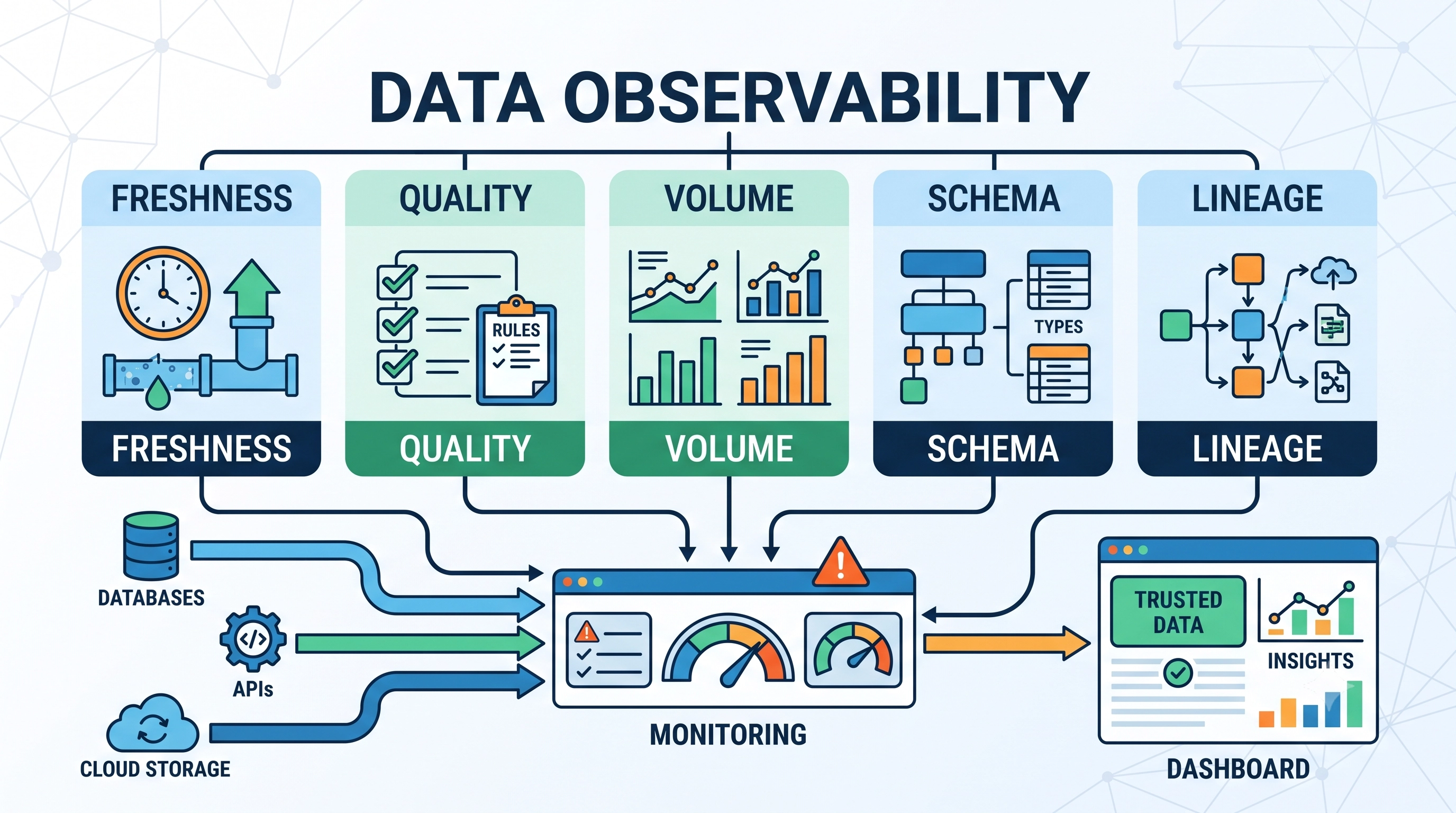
Data Observability platforms typically focus on several key areas to provide a comprehensive view:
- Freshness: Is the data arriving on time? Is it up-to-date?
- Volume: Is the expected amount of data present? Are there sudden drops or spikes?
- Schema: Has the structure or format of the data changed unexpectedly?
- Distribution: Are the values within the data within expected ranges? Are there anomalies or outliers?
- Lineage: Where did the data come from, where is it going, and how has it been transformed along the way?
- Quality: Does the data meet predefined rules and standards (e.g., uniqueness, completeness, validity)?
Benefits of Embracing Data Observability
- Increased Data Trust: Users can confidently rely on data for reporting, analytics, and critical applications.
- Faster Issue Resolution: Proactive alerts and detailed insights enable data teams to quickly identify, diagnose, and resolve data issues before they escalate.
- Reduced Data Downtime: Minimize periods when data is unavailable or unreliable, preventing disruptions to business operations.
- Improved Collaboration: Provides a shared understanding of data health across data engineers, analysts, and business users.
- Better Decision Making: Ensures that all strategic decisions are based on accurate, timely, and high-quality data.
Data Observability vs. Traditional Data Quality
While related, Data Observability goes beyond traditional data quality tools. Traditional tools often focus on fixing known quality issues or validating data against predefined rules at specific points. Data Observability, conversely, offers:
- Proactive Monitoring: Detects unknown issues and anomalies in real-time or near real-time.
- End-to-End Visibility: Covers the entire data pipeline, not just specific datasets or transformation steps.
- Automated Anomaly Detection: Uses machine learning to learn normal data behavior and flag deviations.
- Context and Lineage: Provides a deeper understanding of the "why" and "where" of data issues, tracing them back to their root cause.
Key Takeaways
- Data Observability is critical for maintaining trust and reliability in today's complex data ecosystems.
- It applies software observability principles to data pipelines, offering comprehensive monitoring and alerting.
- Key pillars include freshness, volume, schema, distribution, lineage, and quality.
- It enables faster issue resolution, reduces data downtime, and ensures better business decisions.
- It complements, rather than replaces, traditional data quality efforts by providing proactive, end-to-end insights.
As organizations become increasingly dependent on data, embracing Data Observability is no longer a luxury but a necessity for ensuring data integrity and fostering a truly data-driven culture.
Be the first to leave a comment.
Leave a comment