The Persistent Challenge of Web Performance
In the relentless pursuit of faster web experiences, developers and architects continually battle network latency and protocol inefficiencies. For decades, the Transmission Control Protocol (TCP) has been the bedrock of reliable internet communication, but its fundamental design, particularly its ordered, reliable delivery mechanism, introduces a notorious bottleneck: Head-of-Line (HoL) Blocking. While HTTP/2 brought significant improvements with its multiplexing capabilities, it couldn't fully escape TCP's shadow. Enter HTTP/3 and the revolutionary QUIC protocol, which fundamentally re-architects the transport layer to finally conquer this pervasive problem.
HTTP/2 and TCP's Head-of-Line Blocking
Before HTTP/2, HTTP/1.1 suffered from HoL blocking at the application layer. Each request required its own TCP connection, or requests on a single connection had to be processed sequentially. HTTP/2 addressed this by introducing streams, allowing multiple requests and responses to be interleaved (multiplexed) over a single TCP connection. This was a huge step forward.
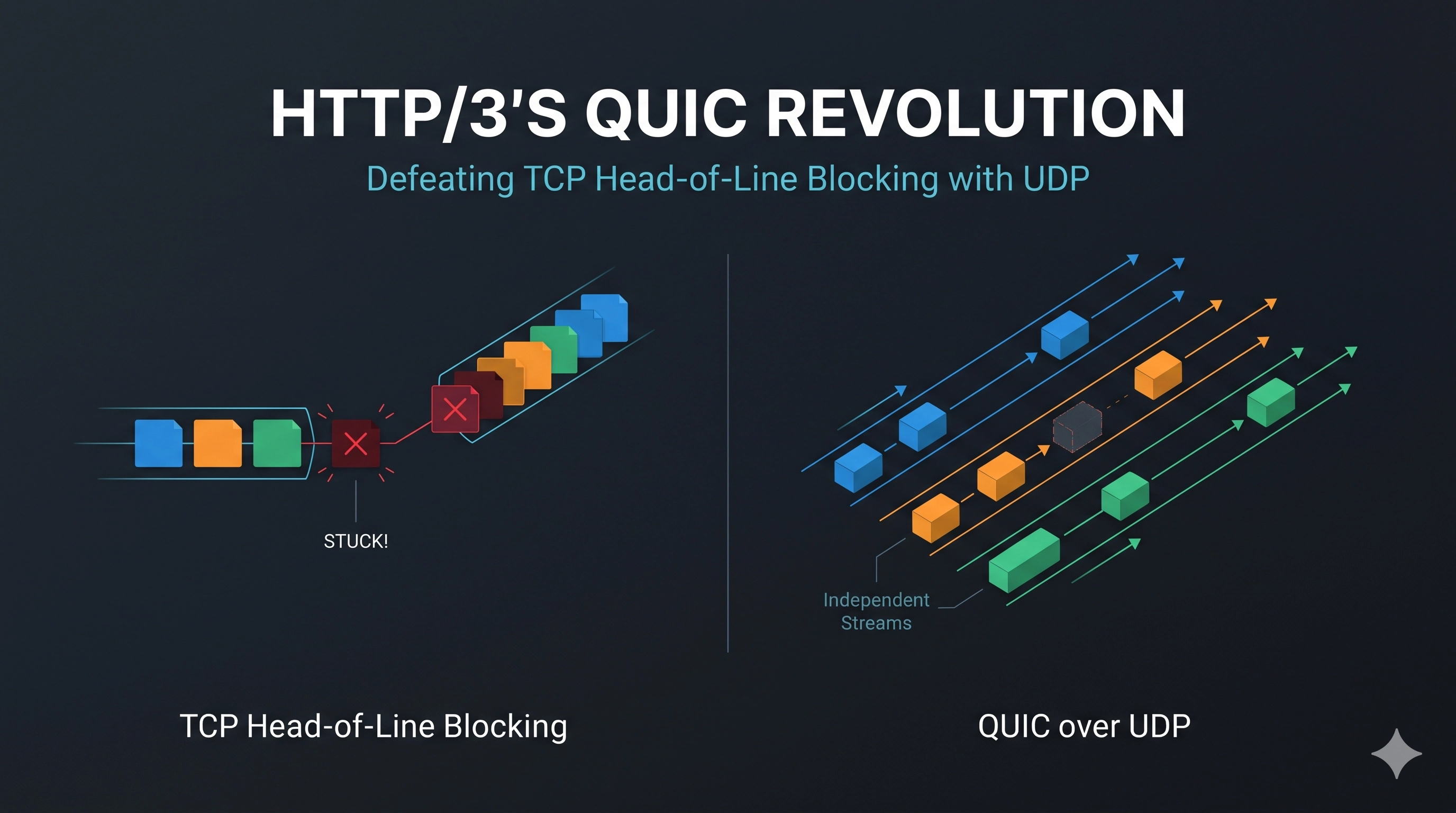
However, HTTP/2 still runs on top of TCP. TCP guarantees ordered delivery of bytes. If any single TCP segment is lost during transmission, TCP's error recovery mechanism dictates that all subsequent segments, regardless of which HTTP/2 stream they belong to, must wait until the lost segment is successfully retransmitted and acknowledged. This waiting period blocks the progress of all active HTTP/2 streams on that connection, even if their data has already arrived. This is the transport-layer HoL blocking that HTTP/2 inherited from TCP.
// Conceptual HTTP/2 (over TCP) Packet Flow
// Client establishes a single TCP connection
Client --- (SYN) -------------------> Server
Client <--- (SYN-ACK) --------------- Server
Client --- (ACK, TLS Handshake) ----> Server
Client <--- (TLS Handshake Done) ---- Server
// TCP connection established. HTTP/2 streams begin for different resources.

// Stream 1 (CSS), Stream 2 (JS), Stream 3 (Image)
Client --- [TCP Segment A: Stream 1 Data] --> Server
Client --- [TCP Segment B: Stream 2 Data] --> Server
Client --- [TCP Segment C: Stream 3 Data] --> Server
Client --- [TCP Segment D: Stream 1 Data] --> Server  // *** This segment is LOST ***
Client --- [TCP Segment E: Stream 2 Data] --> Server
Client --- [TCP Segment F: Stream 3 Data] --> Server

// Server receives A, B, C. All good.
// Server then receives E, F.
// TCP's ordered delivery rule: Server cannot pass E and F to the HTTP/2 layer
// until D is received. All streams are BLOCKED at the TCP layer,
// even though Stream 2 and 3 data (E, F) has arrived.
// TCP retransmits Segment D.
// Once D is received and acknowledged, then E and F can be delivered.
Enter QUIC and HTTP/3: A UDP-Based Revolution
Recognizing that TCP's fundamental design prevented further progress against HoL blocking, the Internet Engineering Task Force (IETF) began work on QUIC (Quick UDP Internet Connections). The most radical decision was to build it on top of UDP (User Datagram Protocol) instead of TCP. Why UDP? Because UDP offers no guarantees of reliability or ordering. It simply sends packets. This lack of inherent order is precisely what allows QUIC to sidestep TCP's HoL blocking.
QUIC essentially re-implements many of the features traditionally found in TCP (reliability, congestion control, flow control) but does so in a way that is stream-aware and independent. It also integrates TLS 1.3 encryption directly into the transport layer, providing security from the very first handshake.
QUIC's Internal Mechanics for HoL Blocking Mitigation
QUIC's design fundamentally tackles HoL blocking at its core:
1. Independent Streams
Unlike HTTP/2 streams which share a single TCP byte stream, QUIC implements its own streams that operate independently. Each QUIC stream has its own flow control and delivery guarantees. If a packet carrying data for Stream A is lost, only Stream A's progress is halted while that specific packet is retransmitted. Other streams (B, C, D) on the same QUIC connection can continue to transmit and receive data without interruption.
2. Per-Packet Loss Recovery
QUIC doesn't rely on TCP's byte-stream sequence numbers. Instead, it uses packet numbers. A lost QUIC packet for one stream doesn't hold up other streams because QUIC's acknowledgment (ACK) system works on a per-packet basis. If Packet X is lost, only Packet X needs retransmission, and its loss does not block delivery of subsequent packets for other streams that have arrived successfully.
// Conceptual HTTP/3 (over QUIC/UDP) Packet Flow
// Client establishes a single QUIC connection (UDP port 443, TLS 1.3 integrated)
Client --- (QUIC Initial Handshake) --> Server
Client <--- (QUIC Handshake Done) --- Server
// QUIC connection established (encrypted from start). HTTP/3 streams begin.

// Stream 1 (CSS), Stream 2 (JS), Stream 3 (Image)
Client --- [QUIC Packet 1: Stream 1 Data] --> Server
Client --- [QUIC Packet 2: Stream 2 Data] --> Server
Client --- [QUIC Packet 3: Stream 3 Data] --> Server
Client --- [QUIC Packet 4: Stream 1 Data] --> Server  // *** This packet is LOST ***
Client --- [QUIC Packet 5: Stream 2 Data] --> Server
Client --- [QUIC Packet 6: Stream 3 Data] --> Server

// Server receives 1, 2, 3. All good.
// Server then receives 5, 6.
// Because QUIC streams are independent, the loss of Packet 4 (Stream 1)
// does NOT block the delivery of Packet 5 (Stream 2) and Packet 6 (Stream 3)
// to the HTTP/3 layer.
// Only Stream 1 waits for the retransmission of Packet 4.
// Stream 2 and 3 continue processing.
3. Faster Connection Establishment with 0-RTT
QUIC's integration of TLS 1.3 into the initial handshake dramatically reduces connection setup latency. For a new connection, it typically requires only a single round-trip (1-RTT) to establish encryption and transport parameters. For resumed connections, QUIC can often achieve 0-RTT, sending application data in the very first packet, eliminating a full round-trip delay that HTTP/2 (over TCP + TLS) would incur.
4. Connection Migration
QUIC connections are identified by a Connection ID, not by the traditional 4-tuple (source IP, source port, destination IP, destination port) used by TCP. This allows a QUIC connection to seamlessly migrate between network interfaces (e.g., from Wi-Fi to cellular) without breaking the connection, renegotiating TLS, or impacting active streams. This is a significant boon for mobile users and improves resilience in dynamic network environments.
Trade-offs and Considerations
While QUIC and HTTP/3 offer substantial performance benefits, their adoption comes with its own set of trade-offs:
- Increased Complexity: Implementing QUIC requires significant effort, as transport layer logic (congestion control, error recovery) moves from the operating system's kernel into the application or user-space library. This can mean higher CPU utilization on the server side compared to relying on a highly optimized kernel TCP stack.
- Firewall and NAT Challenges: Historically, UDP traffic on non-standard ports was often blocked by firewalls or had poor NAT traversal. While HTTP/3 typically uses UDP port 443, making it more likely to pass, some legacy infrastructure might still pose issues. QUIC employs active connection IDs and various techniques to maintain NAT bindings.
- Debugging and Observability: Debugging QUIC can be more challenging than TCP. Traditional network tools (like Wireshark) need to be updated to parse QUIC packets, and server-side metrics must provide insights into QUIC's specific behaviors (stream errors, packet loss, connection migration events) rather than just TCP statistics.
- Server-Side Resources: Operating QUIC in user space might mean the server process needs more memory and CPU cycles to manage connections, streams, and congestion control algorithms, requiring careful resource provisioning.
Production Lessons and Failure Modes
Deploying HTTP/3 and QUIC successfully in production requires thoughtful planning:
- Gradual Rollout and A/B Testing: Start by enabling HTTP/3 for a subset of users or traffic. Monitor performance metrics (latency, error rates, resource utilization) meticulously and compare against HTTP/2.
- Comprehensive Monitoring: Beyond traditional web metrics, invest in monitoring tools that can provide QUIC-specific visibility. Track handshake success rates, 0-RTT usage, stream concurrency, retransmission rates, and connection migration events.
- Network Infrastructure Compatibility: Work with network teams to ensure firewalls, load balancers, and content delivery networks (CDNs) are properly configured to support UDP port 443 traffic and can handle QUIC's statelessness from the perspective of session affinity (though QUIC's connection ID helps here).
- Graceful Fallback: Client implementations must always be prepared to fall back to HTTP/2 if HTTP/3 negotiation fails or the network path is incompatible. This ensures service availability even in suboptimal conditions.
- Optimizing Server Implementations: Choose mature QUIC server implementations and tune their parameters (e.g., stream limits, congestion control algorithms) based on your specific workload and network characteristics.
Key Takeaways
- HTTP/2 significantly improved web performance through multiplexing but was still constrained by TCP's transport-layer Head-of-Line (HoL) blocking.
- HTTP/3, built on the QUIC protocol over UDP, fundamentally solves HoL blocking by implementing independent, reliable streams at the QUIC layer.
- QUIC offers faster connection establishment (0-RTT for resumed connections), improved connection resilience via connection migration, and integrated TLS 1.3 security.
- While providing superior performance, adopting HTTP/3 and QUIC introduces operational complexities related to server resource management, network compatibility, and advanced monitoring requirements.
- Careful planning, comprehensive monitoring, and a robust fallback strategy are essential for successful HTTP/3 deployment in production environments.
Be the first to leave a comment.
Leave a comment