Quantum Computing: The Basics for Curious Minds
In the vast and ever-evolving landscape of technology, certain concepts emerge that challenge our conventional understanding and promise to redefine the future. Quantum computing is undoubtedly one such concept. Often shrouded in complex physics and intimidating jargon, it's easy to dismiss as something only for scientists in labs. But what exactly is quantum computing, and why should we, as curious tech enthusiasts, pay attention?
Beyond Bits: Introducing Qubits
To understand quantum computing, we first need to briefly revisit classical computing. Your smartphone, laptop, and every server on the internet operate using bits. A bit is the most basic unit of information, representing either a 0 or a 1. These clear, binary states are the foundation of all digital logic.
Quantum computers, however, use qubits (quantum bits). Unlike a classical bit, a qubit isn't just a 0 or a 1. Thanks to the strange rules of quantum mechanics, a qubit can be a 0, a 1, or—here's the mind-bending part—both at the same time. This phenomenon is called superposition.
- Superposition: Imagine a spinning coin that is simultaneously heads and tails until it lands. A qubit in superposition exists in a probabilistic combination of states until it's measured. This ability allows quantum computers to store and process far more information than classical computers with the same number of units.
The Power of Entanglement
Another crucial quantum phenomenon that gives quantum computers their unique power is entanglement. When qubits are entangled, they become deeply interconnected. The state of one entangled qubit instantaneously influences the state of another, no matter how far apart they are. Einstein famously called this "spooky action at a distance."
Why is this important? If you have two entangled qubits, knowing the state of one immediately tells you something about the state of the other. This interconnectedness allows quantum computers to perform incredibly complex calculations by linking the computational power of multiple qubits, rather than processing them individually.
Why Does Quantum Computing Matter?
The ability of qubits to exist in superposition and become entangled means quantum computers can explore many possibilities simultaneously, a feat impossible for classical machines. This parallel processing capability opens doors to solving problems that are currently intractable:
- Drug Discovery and Materials Science: Simulating molecular interactions with unprecedented accuracy could revolutionize medicine and engineering.
- Optimization Problems: Finding the most efficient routes, logistics, or financial models in incredibly complex scenarios.
- Cryptography: Potentially breaking current encryption methods (which also spurs the development of quantum-resistant cryptography).
- Artificial Intelligence: Enhancing machine learning algorithms by processing vast datasets in novel ways.
The Road Ahead: Not Replacing Your Laptop (Yet)
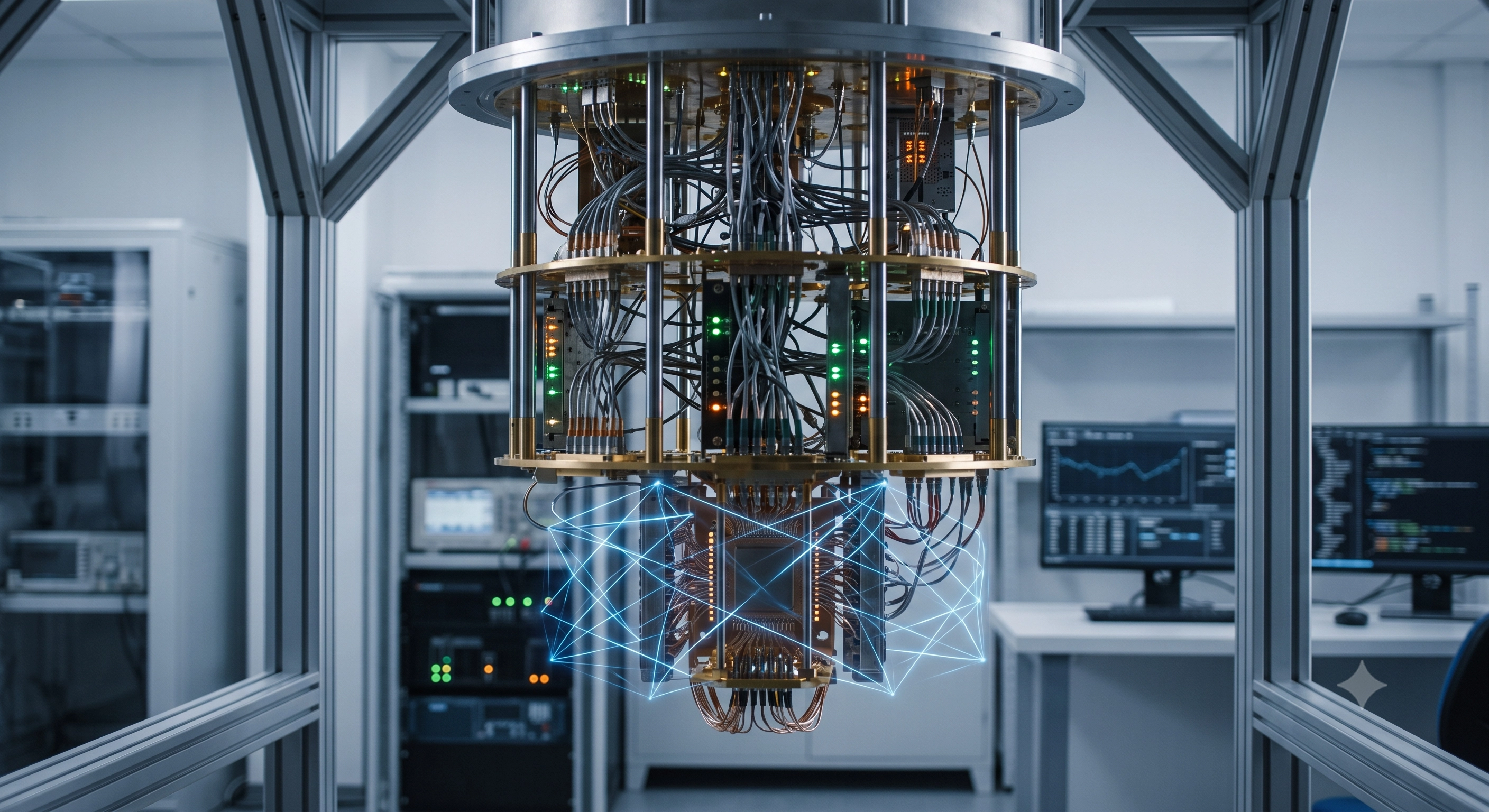
It's important to set realistic expectations. Quantum computers are not designed to replace your personal computer for browsing the web or writing documents. They are specialized tools for specific, incredibly complex computational challenges. The technology is still in its infancy, requiring extremely cold temperatures and shielded environments to maintain the delicate quantum states of qubits.
While major tech companies and research institutions are making significant strides, a practical, error-corrected quantum computer that can tackle real-world problems at scale is still years, if not decades, away. However, the potential impact on fields from healthcare to finance to cybersecurity is immense, making it a technology worth watching closely.
Key Takeaways
- Qubits vs. Bits: Quantum computers use qubits, which can be 0, 1, or both simultaneously (superposition), unlike classical bits (0 or 1).
- Entanglement: Qubits can be linked, so the state of one instantly affects others, enabling complex parallel calculations.
- Problem Solvers: Quantum computing promises to solve currently intractable problems in areas like medicine, materials, and optimization.
- Early Stages: The technology is still developing and is not a general-purpose replacement for classical computers.
Be the first to leave a comment.
Leave a comment