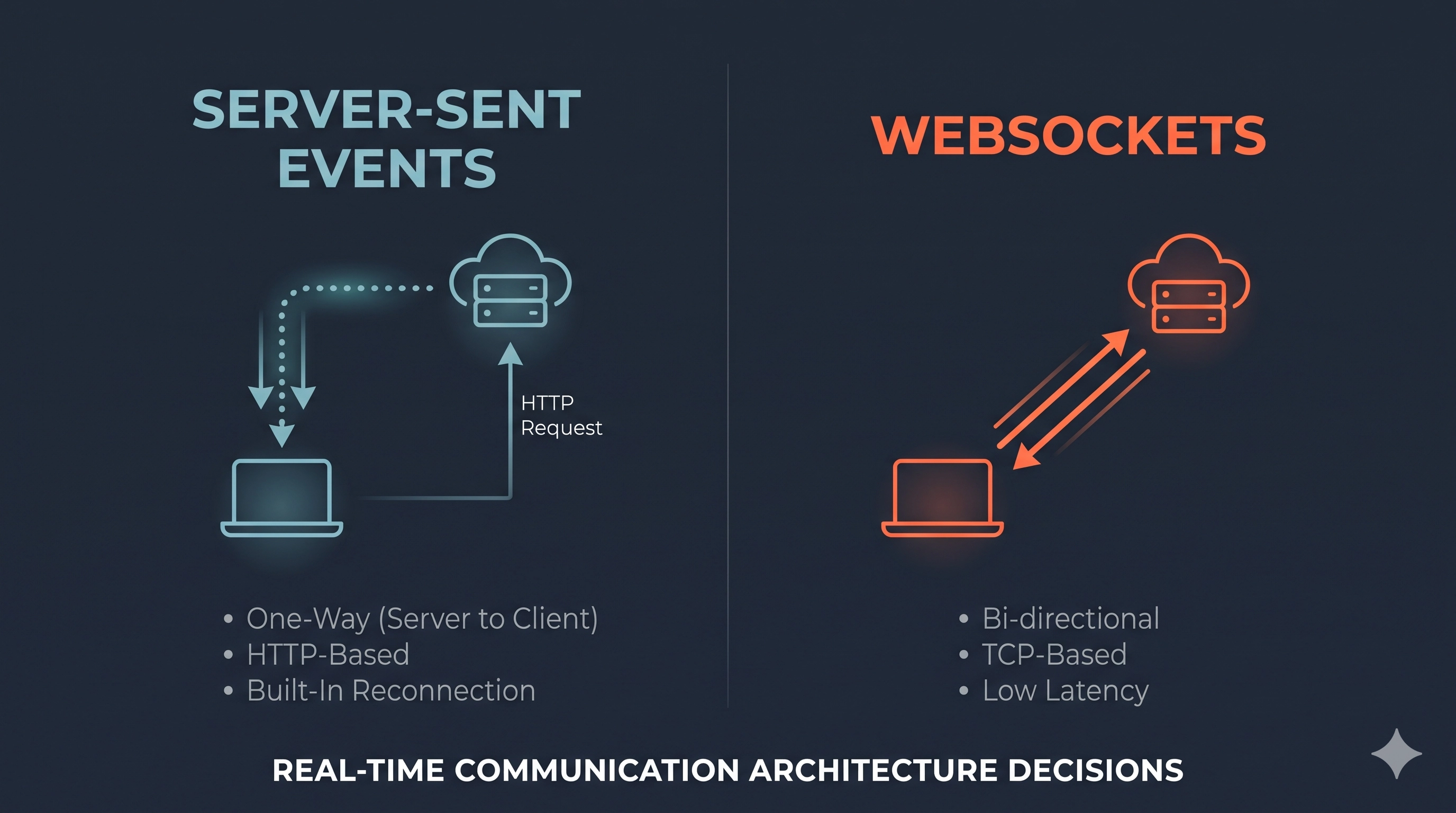
The Quest for Real-Time: SSE vs. WebSockets
In today's fast-paced digital landscape, real-time communication is no longer a luxury but a fundamental expectation. From live dashboards and stock tickers to chat applications and collaborative editing tools, users demand instant updates. As architects and developers, we're faced with critical decisions when choosing the right protocol to power these experiences. Two prominent contenders often emerge: Server-Sent Events (SSE) and WebSockets.
While both enable real-time capabilities, they operate on fundamentally different principles and excel in distinct scenarios. A superficial understanding can lead to architectural missteps, operational headaches, and scaling challenges down the line. This post dives deep into SSE and WebSockets, comparing their mechanics, operational implications, and guiding you through the decision-making process.
Server-Sent Events (SSE): Unidirectional Simplicity Over HTTP
Server-Sent Events is a standard built on top of HTTP, allowing a server to push data to a client over a single, long-lived HTTP connection. It's inherently unidirectional, meaning data flows from the server to the client. This makes it ideal for scenarios where the client primarily consumes a stream of updates and rarely needs to send data back to the server in a real-time fashion.
How SSE Works
When a client initiates an SSE connection, it sends a standard HTTP request. The server responds with a special Content-Type: text/event-stream header, indicating that it will be streaming events. The connection remains open, and the server sends messages formatted as a series of data: lines, terminated by two newlines (\n\n). Browsers inherently support SSE via the EventSource API.
A key advantage of SSE is its built-in reconnection mechanism. If the connection drops, the browser automatically attempts to reconnect, optionally using a Last-Event-ID header to resume from the last received event, preventing data loss.
Pros of SSE:
- Simplicity: It leverages standard HTTP, making it easy to implement on both client and server sides.
- Automatic Reconnection: The browser's
EventSourceAPI handles reconnections gracefully, reducing client-side complexity. - HTTP Compatibility: Works seamlessly with existing HTTP infrastructure, including proxies, load balancers, and CDNs (though caching for event streams is usually undesired).
- Lower Overhead (Unidirectional): For server-to-client only communication, the overhead is generally lower than WebSockets due to simpler handshaking and protocol.
Cons of SSE:
- Unidirectional: Not suitable for applications requiring bidirectional, low-latency communication (e.g., chat).
- Connection Limits: Browsers typically limit the number of concurrent HTTP connections to a single domain (e.g., 6 connections), which can become a bottleneck for applications with many parallel SSE streams from the same origin.
- Text-based Data: Primarily designed for UTF-8 encoded text; binary data requires encoding (e.g., Base64).
SSE Server Example (Node.js/Express-like Pseudocode)
app.get('/events', (req, res) => {
  res.setHeader('Content-Type', 'text/event-stream');
  res.setHeader('Cache-Control', 'no-cache');
  res.setHeader('Connection', 'keep-alive');
  res.flushHeaders(); // Important for SSE to send headers immediately

  // Keep the connection alive with periodic pings
  const intervalId = setInterval(() => {
    res.write('data: ping

'); // Send a no-op event
  }, 15000); // Every 15 seconds

  const sendData = (data) => {
    res.write(`data: ${JSON.stringify(data)}

`);
  };

  let counter = 0;
  const dataInterval = setInterval(() => {
    sendData({ message: `Update ${counter++}`, timestamp: new Date().toISOString() });
  }, 3000);

  req.on('close', () => {
    clearInterval(intervalId);
    clearInterval(dataInterval);
    console.log('Client disconnected from SSE stream');
  });
});
SSE Client Example (JavaScript)
const eventSource = new EventSource('/events');
eventSource.onopen = () => {
console.log('SSE connection established.');
};
eventSource.onmessage = (event) => {
console.log('Received SSE message:', event.data);
const data = JSON.parse(event.data);
document.getElementById('realtime-feed').innerHTML += `Event: ${data.message} at ${new Date(data.timestamp).toLocaleTimeString()}
`;
};
eventSource.onerror = (error) => {
console.error('SSE Error:', error);
// EventSource will automatically attempt to reconnect
};
WebSockets: Full-Duplex, Low-Latency Communication
WebSockets provide a full-duplex communication channel over a single, long-lived TCP connection. Unlike SSE, which uses HTTP for streaming, WebSockets establish a persistent connection after an initial HTTP handshake. This allows for true bidirectional, low-latency communication, where both client and server can send and receive data independently at any time.
How WebSockets Work
The WebSocket connection begins with a standard HTTP GET request, including an Upgrade: websocket header. If the server supports WebSockets, it responds with an 101 Switching Protocols status, and the connection is then 'upgraded' from HTTP to the WebSocket protocol. Once upgraded, the connection operates independently of HTTP, using a much lighter framing protocol for data transfer.
WebSockets are ideal for interactive applications that require constant, rapid exchange of small messages between client and server.
Pros of WebSockets:
- Full-Duplex Communication: Both client and server can send and receive messages asynchronously, making it perfect for chat, gaming, and collaborative tools.
- Low Latency: Once the connection is established, there's minimal overhead for subsequent messages, leading to very low latency.
- Efficient for Small, Frequent Messages: Reduced overhead compared to repeated HTTP requests.
- Binary Data Support: Can send and receive binary data efficiently.
Cons of WebSockets:
- Operational Complexity: Requires stateful server implementations and more complex load balancing (often sticky sessions) to ensure clients reconnect to the same server.
- No Built-in Reconnection: The WebSocket API itself does not include automatic reconnection; this logic must be implemented manually on the client side.
- Proxy/Firewall Issues: Older proxies or firewalls might not correctly handle WebSocket upgrade requests, requiring specific configurations.
- Higher Connection Overhead: While message overhead is low, establishing and maintaining many persistent TCP connections can consume more server resources than numerous short-lived HTTP connections for SSE.
WebSocket Client Example (JavaScript)
const ws = new WebSocket('ws://localhost:8080');

ws.onopen = () => {
  console.log('Connected to WebSocket server');
  ws.send('Hello from client!');
};

ws.onmessage = (event) => {
  console.log('Received WebSocket message:', event.data);
  document.getElementById('realtime-status').innerText = `Message: ${event.data}`;
};

ws.onclose = () => {
  console.log('Disconnected from WebSocket server. Attempting to reconnect...');
  // In a real application, implement robust exponential backoff reconnection logic here.
};

ws.onerror = (error) => {
  console.error('WebSocket Error:', error);
};

// Example of sending a message from the client
function sendMessage(message) {
  if (ws.readyState === WebSocket.OPEN) {
    ws.send(message);
  } else {
    console.warn('WebSocket not open, cannot send message.');
  }
}
Architectural Comparison & Decision Framework
Choosing between SSE and WebSockets boils down to your application's specific requirements. Here's a comparative overview:
- Directionality:
- SSE: Server-to-client (unidirectional). Perfect for broadcasting updates.
- WebSockets: Bidirectional (full-duplex). Essential for interactive, collaborative applications.
- Underlying Protocol:
- SSE: HTTP. Benefits from existing HTTP infrastructure.
- WebSockets: Custom protocol over TCP (after HTTP handshake). More resource-intensive for server connections.
- Automatic Reconnection:
- SSE: Built-in via
EventSourceAPI. - WebSockets: Requires manual client-side implementation.
- SSE: Built-in via
- Load Balancing & Scaling:
- SSE: Easy. Standard HTTP load balancers work well; servers are typically stateless.
- WebSockets: More complex. Often requires sticky sessions or a separate pub/sub layer (e.g., Redis, Kafka) for message routing to specific clients or broadcasting across multiple server instances.
- Message Format:
- SSE: Text-based (UTF-8).
- WebSockets: Text or binary.
- Overhead:
- SSE: Initial HTTP overhead, but low per-message for streaming.
- WebSockets: Initial HTTP upgrade handshake, then very low per-message overhead. Higher connection footprint.
When to Choose SSE:
- When your application primarily needs to push real-time data from the server to the client. Think news feeds, stock tickers, activity streams, live dashboards, application logs, or any scenario where the server is the primary source of updates, and the client only consumes.
- When simplicity, leveraging existing HTTP infrastructure, and automatic reconnection are high priorities.
- When the number of concurrent connections per domain might exceed typical browser HTTP limits (though less common, it's a consideration).
When to Choose WebSockets:
- When your application requires true bidirectional, low-latency communication. Think chat applications, online gaming, collaborative editing, real-time analytics dashboards with user interaction, or VoIP.
- When frequent, small messages need to be exchanged rapidly between client and server.
- When you need to send and receive binary data efficiently.
- When you are prepared to manage the increased operational complexity, including implementing client-side reconnection logic and potentially more sophisticated load balancing or message broker architectures.
Production Lessons & Operational Trade-offs
Deploying real-time applications requires careful consideration beyond just protocol choice:
- Resource Management: Both SSE and WebSockets maintain persistent connections, consuming server memory and CPU. Monitor connection count and resource usage closely. WebSockets generally demand more resources per connection.
- Heartbeats/Pings: For both protocols, implement periodic heartbeats (ping/pong frames for WebSockets, or simple
data: pingevents for SSE) to detect dead connections and prevent intermediaries from timing out inactive connections. - Proxy Configuration: Ensure your reverse proxies (Nginx, HAProxy, etc.) are correctly configured to handle long-lived connections for SSE and WebSocket upgrade requests. For WebSockets, this often means enabling WebSocket proxying and possibly sticky sessions.
- Scaling Stateful vs. Stateless: SSE servers can often remain stateless and scale easily behind standard load balancers. WebSocket servers, being stateful (each client connection exists on a specific server), require careful scaling strategies, such as sticky sessions or integrating with a message bus (like Redis Pub/Sub, Apache Kafka) to allow any server to handle any client connection while distributing messages efficiently.
- Client-Side Resilience: While SSE has built-in reconnection, robust client-side logic is still crucial for both. For WebSockets, this means implementing exponential backoff for reconnect attempts, message queuing during disconnection, and potentially message idempotency.
Key Takeaways
- SSE is for Unidirectional Streams: Best for server-to-client data push where simplicity and HTTP compatibility are key.
- WebSockets are for Bidirectional Interaction: Ideal for low-latency, full-duplex communication in highly interactive applications.
- Operational Complexity Matters: SSE generally offers simpler scaling and operational overhead due to its HTTP nature. WebSockets introduce more complexity in server state management, load balancing, and client-side resilience.
- Choose Wisely: The right choice depends entirely on your application's communication patterns and the architectural trade-offs you're willing to make. Don't over-engineer with WebSockets if SSE suffices.
Be the first to leave a comment.
Leave a comment