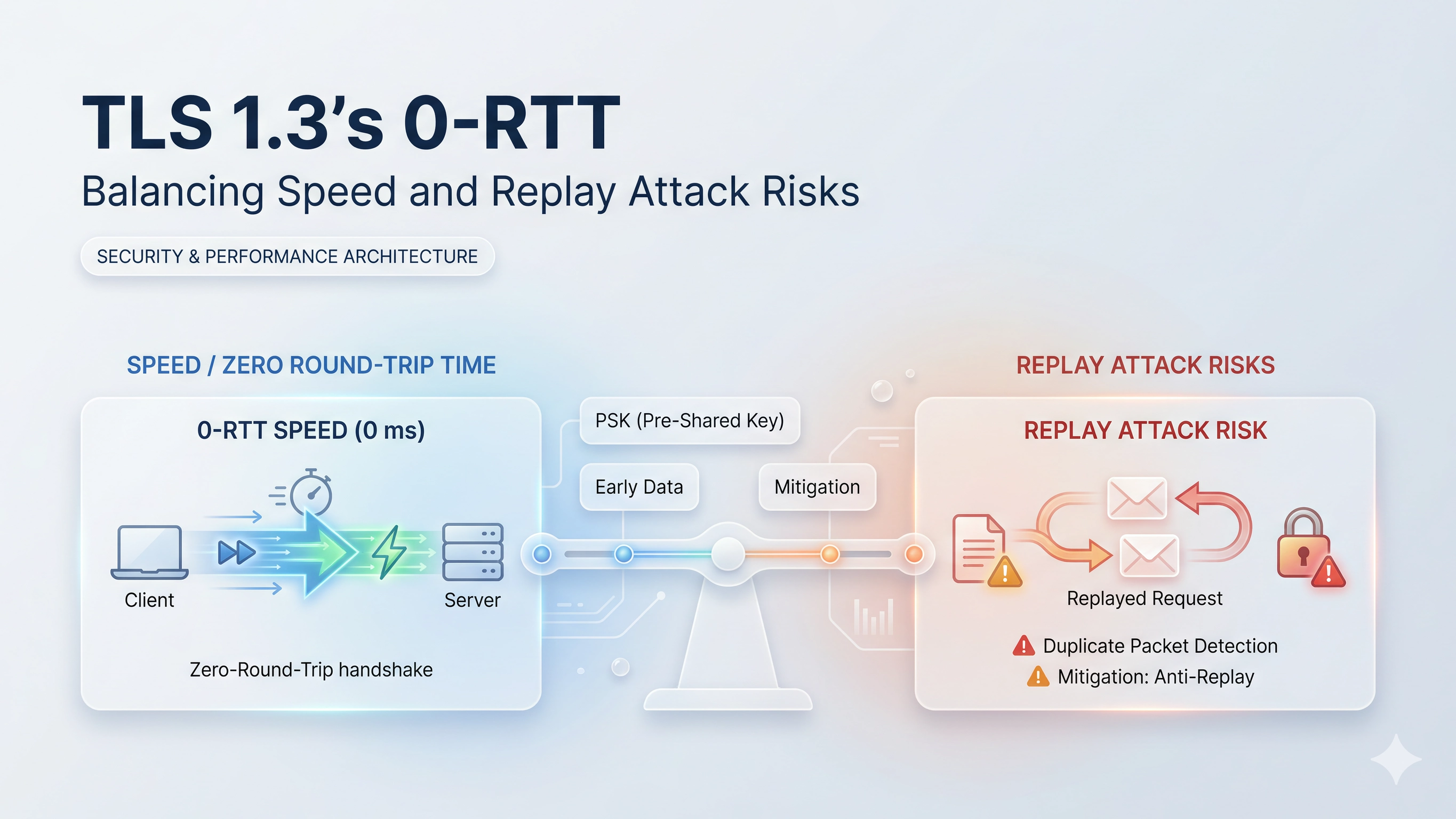
The Quest for Low-Latency Secure Connections
In the world of web performance, every millisecond counts. Secure communication, while paramount, often introduces latency due to the cryptographic handshakes required to establish a secure channel. Traditional TLS 1.2 handshakes, especially full handshakes, require multiple round trips before application data can even be sent, impacting user experience and application responsiveness. TLS 1.3 arrived with a promise of significant performance improvements, and one of its most compelling features is Zero Round-Trip Time (0-RTT) resumption. But as with any performance gain, there are trade-offs – specifically, a non-trivial security risk: the replay attack.
The Evolution of TLS Handshakes
TLS 1.2: The 2-RTT Baseline (and 1-RTT Resumption)
Before TLS 1.3, establishing a new secure connection with TLS 1.2 typically involved two full round-trip times (2-RTT) just for the handshake:
- The client sends a
ClientHello. - The server responds with a
ServerHello, its certificate, and aServerKeyExchange. - The client verifies the certificate, sends its
ClientKeyExchange, and aChangeCipherSpec. - The server responds with a
ChangeCipherSpecand both sendFinishedmessages.
For subsequent connections, TLS 1.2 offered session resumption via session IDs or tickets, reducing the handshake to one round-trip (1-RTT). While better, it still meant waiting a full RTT before any application data could be exchanged.
TLS 1.3: A Streamlined 1-RTT Handshake
TLS 1.3 dramatically simplified the handshake process, making it faster by design. A full handshake now takes only one round-trip:
- The client sends a
ClientHellocontaining its supported cipher suites and proposed key shares (often elliptic curve parameters). - The server responds with a
ServerHello, selecting a cipher suite and key share, its certificate, and its encryptedExtensions. - Both client and server compute the master secret and send their respective
Finishedmessages.
Critically, the client already sends its key shares in the first message, allowing the server to immediately respond with its own key material and encrypted handshake messages, thus achieving 1-RTT for new connections.
Unpacking TLS 1.3's 0-RTT: Speed at a Cost
How 0-RTT Works: Pre-Shared Keys and Early Data
0-RTT takes the 1-RTT concept even further. If a client has connected to a server previously and stored a Pre-Shared Key (PSK) along with associated context (like ALPN and server name), it can use this PSK to send encrypted application data in its very first flight of messages – specifically, within the ClientHello. This effectively means zero round trips before the first application data bytes are transmitted.
Here's a simplified breakdown:
- Previous Session: During a prior TLS 1.3 handshake, the server issues a
NewSessionTicketmessage to the client. This ticket contains a PSK identity and an encrypted PSK. The client stores this. - 0-RTT Resumption: When reconnecting, the client includes the PSK identity in its
ClientHellowithin thepre_shared_keyextension. It also includes anearly_dataextension and the encrypted application data it wishes to send immediately. - Key Derivation: Using the PSK, both client and server can derive an 'early secret' and then an 'early traffic secret'. This early traffic secret is used to encrypt the 0-RTT application data.
The magic is that the server can immediately decrypt and process this early data upon receiving the ClientHello, even before it has sent its ServerHello or completed the full handshake.
The Replay Attack Vector in 0-RTT
The fundamental challenge with 0-RTT is that the early data sent by the client is not fully authenticated. The client provides the PSK identity, but the server hasn't yet verified that the client is indeed the legitimate owner of that PSK or that the ClientHello itself hasn't been replayed. This opens a critical window for replay attacks.
A replay attack occurs when a malicious actor intercepts a valid data transmission and re-transmits it later, impersonating the original sender to trick the recipient into performing the same action again.
With 0-RTT, if an attacker intercepts a ClientHello containing early application data, they can replay this entire message to the server. If the server processes this early data without adequate replay protection, it might execute the same operation multiple times. For example:
- A
POST /transferrequest that moves money. - A
PUT /update_user_statusrequest that changes a user's state.
Such operations are typically non-idempotent, meaning performing them multiple times has different (and usually undesirable) effects than performing them once. Idempotent operations (like GET /resource or PUT /resource/id where the final state is always the same) are generally safer for 0-RTT, but the server still needs to be careful.
Mitigating Replay Risks: Server-Side Approaches
Due to the inherent replay risk, servers implementing 0-RTT must employ robust anti-replay mechanisms. The TLS 1.3 specification mandates that servers must be able to detect and reject replayed 0-RTT data to the extent possible. Common strategies include:
- Single-use Session Tickets: The server generates session tickets with unique nonces or sequence numbers. Each ticket is intended for a single 0-RTT use. If a ticket is replayed, the server can detect this and reject the early data. However, robustly enforcing single-use across a distributed system can be complex.
- Anti-Replay Caches: The server maintains a short-lived cache of nonces or digests of early data received within a certain time window. Before processing 0-RTT data, it checks if a similar request has already been seen. This requires careful synchronization in clustered environments.
- Early Data Indicators and Application-Layer Logic: The server might expose an indicator to the application layer (e.g., via a header or a flag in the request object) that the current request arrived as 0-RTT early data. The application can then decide how to handle it:
- For strictly idempotent requests (like
GET), it might proceed. - For non-idempotent requests (like
POST,PUT,DELETE), it might buffer the request and only process it after the full handshake is completed and authentication is confirmed, or outright reject it with an error.
The challenge lies in balancing replay protection with the performance benefits of 0-RTT. Overly aggressive replay protection can negate the speed gains, while insufficient protection introduces significant security vulnerabilities.
Production Considerations for 0-RTT
When deploying services with TLS 1.3 0-RTT, careful configuration and architectural decisions are crucial:
- When to Enable: 0-RTT is excellent for use cases where latency is critical and requests are naturally idempotent or have strong application-layer replay protection. Think of CDN edge nodes serving static assets, or read-heavy API endpoints (e.g., fetching user profiles).
- When to Disable/Be Cautious: Avoid 0-RTT for financial transactions, state-changing API calls, or any sensitive operation where a replay could lead to adverse effects. Many web servers and load balancers allow granular control over 0-RTT.
- Server-Side Configuration: Ensure your web server (e.g., Nginx, Apache) or TLS termination proxy is configured correctly to manage session tickets and apply anti-replay measures. The specific directives vary by software version and vendor, but typically involve enabling
ssl_early_dataand managing session tickets.
# Nginx example (conceptual, actual configuration depends on Nginx version and OS)
# Ensure TLS 1.3 is enabled
ssl_protocols TLSv1.3;

# Enable 0-RTT for specific server blocks or locations
# Only enable where replay risks are acceptable or handled by application
server {
    listen 443 ssl http2;
    ssl_early_data on; # This enables 0-RTT for compatible clients
    ssl_session_tickets on;
    ssl_session_timeout 1d;

    location /static/ {
        # Good candidate for 0-RTT as static asset fetches are idempotent
        # ...
    }

    location /api/transfer/ {
        # NOT a good candidate for 0-RTT if it's a POST request
        # Application layer MUST handle early data risk if 0-RTT is enabled
        # ...
    }
}
- Application-Layer Awareness: Even with server-side mitigations, it's prudent for applications to be aware of whether a request arrived via 0-RTT. Modern web frameworks or API gateways can often expose this information, allowing your application logic to make informed decisions.
- Monitoring: Monitor your TLS 0-RTT success rates, any rejected early data requests (which might indicate replay attempts), and overall latency metrics to ensure the feature is behaving as expected without introducing new vulnerabilities.
Key Takeaways
- TLS 1.3's 0-RTT feature significantly reduces connection latency by allowing clients to send application data in their first message.
- This speed comes with an inherent security trade-off: 0-RTT data is vulnerable to replay attacks because it's sent before the client is fully authenticated.
- Robust server-side anti-replay mechanisms (e.g., single-use tickets, anti-replay caches, application-layer awareness) are critical for safe 0-RTT deployment.
- 0-RTT is best suited for idempotent requests (like
GETfor static assets) and should be used with extreme caution or disabled for non-idempotent, state-changing operations.
Be the first to leave a comment.
Leave a comment