The Transactional Outbox Pattern: Preventing Event Loss in Microservices
In distributed systems built with microservices, achieving consistency across services is one of the toughest challenges. A common scenario involves a service performing a database operation and then publishing an event to notify other services. For instance, a UserService might create a new user and then publish a UserCreatedEvent. What happens if the database transaction commits successfully, but the event publishing fails? You end up with an inconsistent state: a new user exists in one service, but other dependent services are unaware.
The Naive Approach and Its Hidden Dangers
Many engineers initially resort to a straightforward approach:
public void createUser(User user) {
    userRepository.save(user); // Database operation
    eventPublisher.publish(new UserCreatedEvent(user.getId())); // Publish event
}
This seems simple enough, but it's fraught with peril in a production environment:
- Crash After Save, Before Publish: The application instance might crash immediately after
userRepository.save(user)commits, but beforeeventPublisher.publish()executes. The user is created, but the event is lost. Dependent services will never know. - Network/Broker Failure: The message broker (e.g., Kafka, RabbitMQ) might be temporarily unavailable or experience a network partition.
eventPublisher.publish()fails, and again, the event is lost. - Retries Lead to Duplicates: If you add a retry mechanism to
eventPublisher.publish(), what if the publish succeeds but the acknowledgment back to the service fails? A retry would send a duplicate event. While consumers should be idempotent, relying on this for all cases is risky without guaranteed "at-least-once" delivery and careful coordination.
The core problem here is the lack of atomicity. The database operation and the event publishing are two separate actions, and there's no single transaction encompassing both.
The Transactional Outbox Pattern: Guaranteeing Atomicity
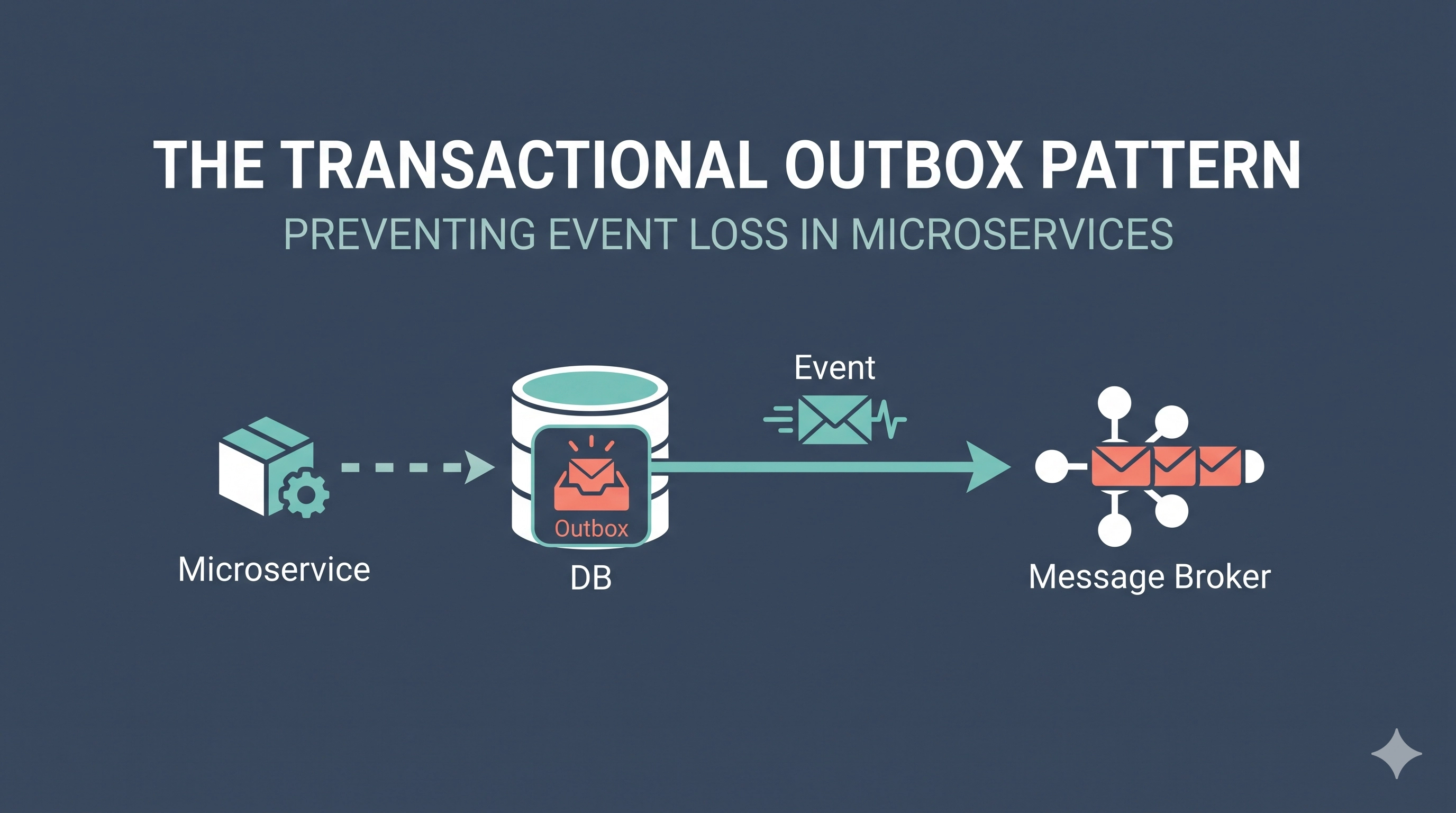
The Transactional Outbox Pattern solves this by ensuring that database updates and event publishing are treated as a single, atomic operation. It leverages your service's existing database transaction to also "publish" events.
How it Works:
- Outbox Table: Introduce a new table in your service's database, typically named
outbox(ordomain_events), with columns likeid,aggregate_id,type,payload(JSON/byte array),created_at, andprocessed_at. - Atomic Save: When a business operation occurs (e.g., creating a user), you save the business entity (the
User) and a corresponding event (UserCreatedEvent) into theoutboxtable within the same database transaction. - Event Relay: A separate, dedicated process or service (the "Outbox Relay" or "Event Dispatcher") continuously polls the
outboxtable for new, unprocessed events. - Publish and Mark: When the Relay finds new events, it publishes them to the message broker. After successful publishing, it updates the
processed_atcolumn of those events in theoutboxtable.
Code Example (Conceptual):
Here's how the createUser method might look with the Outbox Pattern:
// Inside a transaction scope
public void createUserWithOutbox(User user) {
    try {
        // Start transaction (or assume an existing one via @Transactional)
        // ...

        userRepository.save(user); // Save business data

        // Create and save an event to the outbox table within the SAME transaction
        OutboxEvent outboxEvent = new OutboxEvent(
            UUID.randomUUID(),
            user.getId().toString(),
            "UserCreatedEvent",
            objectMapper.writeValueAsString(new UserCreatedEvent(user.getId()))
        );
        outboxRepository.save(outboxEvent);

        // Commit transaction
        // ...
    } catch (Exception e) {
        // Rollback transaction
        // ...
        throw e;
    }
}
The OutboxEvent would typically be a simple data structure reflecting the event details. The outboxRepository.save(outboxEvent) happens before the transaction commits. If anything fails before the commit, both the user and the event are rolled back. If the commit succeeds, both are persisted, guaranteeing that the event will eventually be published.
Production Lessons and Considerations
- At-Least-Once Delivery: The Outbox Pattern guarantees "at-least-once" delivery. This means consumers of your events must be idempotent – able to process the same event multiple times without undesired side effects. This is a non-negotiable requirement for robust distributed systems.
- Relay Process Resilience: The Outbox Relay should be robust. It needs its own retry mechanisms for publishing to the message broker, error logging, and potentially dead-letter queues if events cannot be published after multiple attempts. Multiple instances of the relay can run for high availability, but care must be taken to ensure only one processes a given event (e.g., using distributed locks or
FOR UPDATE SKIP LOCKEDin SQL). - Polling vs. Change Data Capture (CDC): The simplest Relay implementation uses polling (e.g.,
SELECT * FROM outbox WHERE processed_at IS NULL ORDER BY created_at LIMIT N). While easy to implement, polling can add load to your database. For high-volume systems, consider Change Data Capture (CDC) tools (like Debezium with Kafka Connect) that read the database transaction log (WAL) and stream changes directly, offering near real-time, low-overhead event publishing. CDC is more complex to set up but provides a more elegant and scalable solution. - Event Archiving/Cleanup: The
outboxtable can grow indefinitely. Implement a cleanup strategy to periodically remove old, processed events. - Monitoring: Monitor the latency between an event being inserted into the outbox and it being successfully published. Long delays indicate issues with your Relay process.
Key Takeaways
- Naive event publishing without atomicity leads to data inconsistencies and lost business events in microservices.
- The Transactional Outbox Pattern uses the database's transaction to atomically save business data and associated events.
- A separate "Relay" process polls the outbox table, publishes events, and marks them as processed.
- Consumers must be idempotent as the pattern guarantees at-least-once delivery.
- Consider CDC for high-volume scenarios to reduce database polling overhead.
- Regularly clean up processed events from the outbox table and monitor relay latency.
Be the first to leave a comment.
Leave a comment