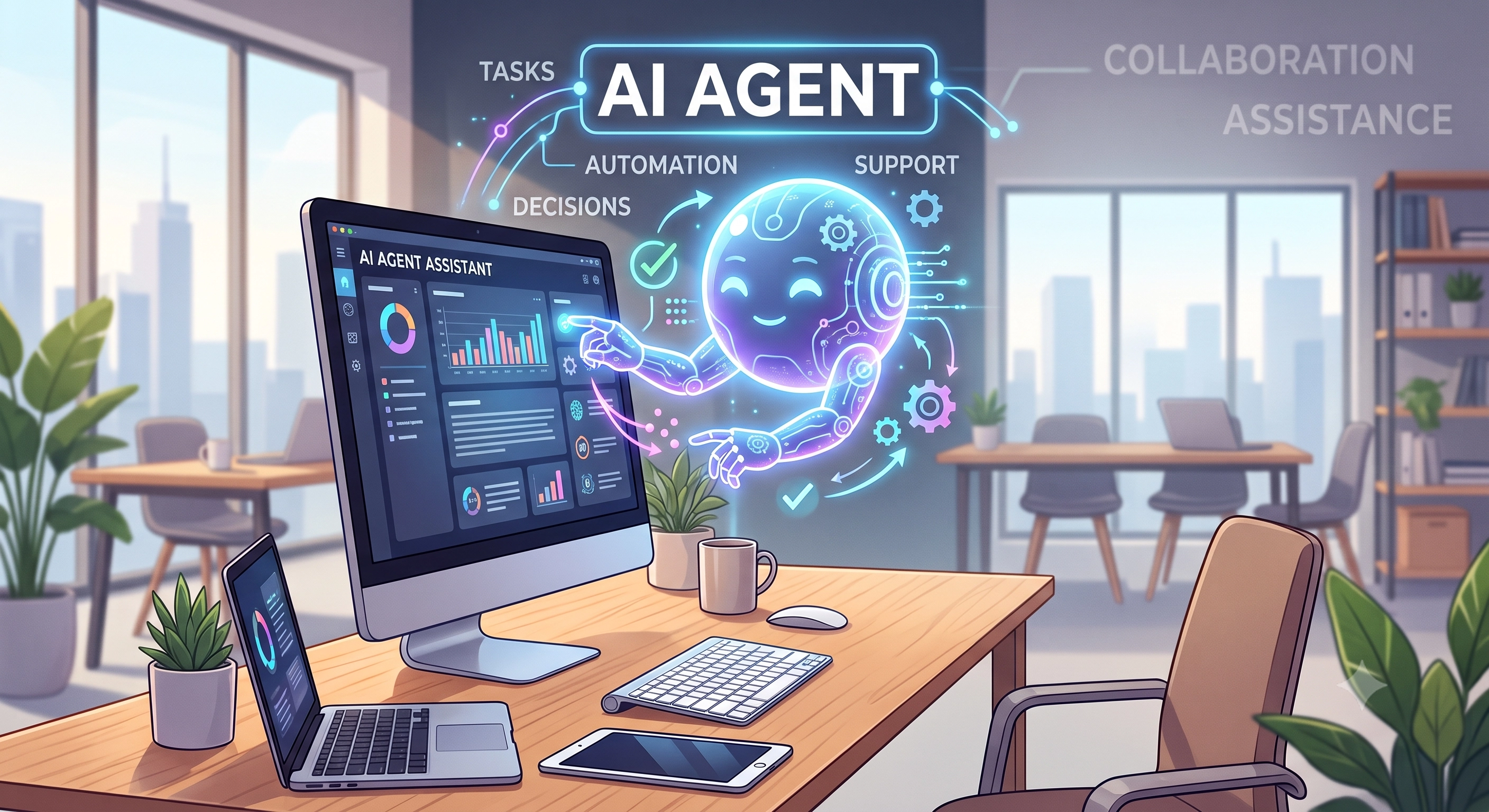
AI Agents: The Next Frontier in Personal and Business Automation
In the rapidly evolving landscape of artificial intelligence, we're witnessing a shift from reactive AI systems to proactive, autonomous entities known as AI agents. Unlike traditional AI tools that merely respond to specific prompts, AI agents are designed to understand complex goals, break them down into actionable steps, execute those steps using various tools, and even learn and adapt over time. They represent a significant leap towards more intelligent and independent automation.
What Defines an AI Agent?
At their core, AI agents possess several key characteristics that distinguish them:
- Goal-Oriented: Every agent is given a specific objective, from "plan my next vacation" to "analyze market trends for Q3."
- Perception: They can interpret information from their environment, whether it's text, data, images, or even sensor inputs.
- Reasoning & Planning: Agents can strategize and outline a sequence of actions required to achieve their goal. This often involves breaking a large goal into smaller, manageable sub-tasks.
- Action: They are equipped to interact with the digital world. This could mean making API calls, browsing the web, sending emails, manipulating data, or generating content.
- Memory & Learning: Many advanced agents can store past interactions and outcomes, learning from their successes and failures to improve future performance.
How Do AI Agents Work?
Imagine giving an AI agent a complex task, such as "research the top five sustainable energy stocks and draft an investment summary." Here's a simplified view of its process:
- The agent receives the high-level goal.
- It uses its reasoning capabilities to determine the necessary sub-tasks: search for sustainable energy companies, find their stock performance, analyze financial reports, identify key investment metrics, and then synthesize this into a summary.
- For each sub-task, the agent selects appropriate "tools" – perhaps a web search engine for initial discovery, a financial data API for stock performance, and a large language model (LLM) for drafting the summary.
- It executes these actions iteratively, evaluating its progress and making adjustments if a sub-task isn't yielding the desired results.
- Finally, it compiles the information and presents the investment summary, potentially asking for feedback to refine future tasks.
Real-World Applications and Use Cases
The potential for AI agents to revolutionize various sectors is immense:
- Personal Assistants: Beyond simple scheduling, agents could proactively book travel based on preferences, manage complex expense reports, or even help learn a new skill by curating resources.
- Business Automation:
- Customer Support: Intelligent agents can resolve complex queries by accessing multiple databases and even initiating follow-up actions.
- Data Analysis: Agents can scour vast datasets, identify trends, and generate reports without constant human intervention.
- Marketing & Content Creation: From drafting social media posts to generating personalized email campaigns, agents can significantly boost productivity.
- Software Development: Assisting with code generation, debugging, and even deployment tasks.
- Research & Development: Accelerating scientific discovery by autonomously searching literature, running simulations, and forming hypotheses.
Challenges and Ethical Considerations
While promising, the deployment of AI agents comes with significant challenges:
- Safety and Control: Ensuring agents don't perform unintended or harmful actions, especially when granted autonomy.
- Ethical Concerns: Issues of bias in decision-making, accountability for agent actions, and privacy of data.
- Complexity and Debugging: Managing intricate agent workflows and troubleshooting when things go wrong can be difficult.
- Over-reliance: The risk of humans becoming too dependent on agents, potentially diminishing critical thinking and oversight.
The true power of AI agents lies not just in their ability to perform tasks, but in their capacity to autonomously identify, plan, and execute a series of steps towards a high-level goal, making them a game-changer for productivity.
Key Takeaways
- Evolution of AI: AI agents represent a shift from reactive tools to proactive, autonomous systems.
- Core Capabilities: They are defined by their goal-orientation, perception, reasoning, action, and memory.
- Broad Applications: From personal assistance to complex business automation and scientific research, their potential is vast.
- Challenges Ahead: Safety, ethics, and the need for human oversight are critical considerations for their responsible development and deployment.
As AI agents continue to evolve, they promise to redefine productivity and automation, making complex tasks more manageable and opening new possibilities for innovation across industries. The journey towards truly intelligent and autonomous assistants is just beginning.
Be the first to leave a comment.
Leave a comment