The Data Dilemma: Utility vs. Privacy
In our increasingly data-driven world, organizations constantly collect vast amounts of information. This data is invaluable for understanding trends, improving services, and making informed decisions. However, this immense utility comes with a significant challenge: how do we harness the power of big data without infringing on individual privacy? The answer often lies in a sophisticated technique called Differential Privacy.
Imagine a scenario where you want to understand the average income of a city's residents without revealing any single person's salary. Or a health researcher wants to study disease patterns across millions of patients without disclosing anyone's specific medical records. Differential Privacy offers a mathematically rigorous framework to achieve precisely this balance.
What is Differential Privacy?
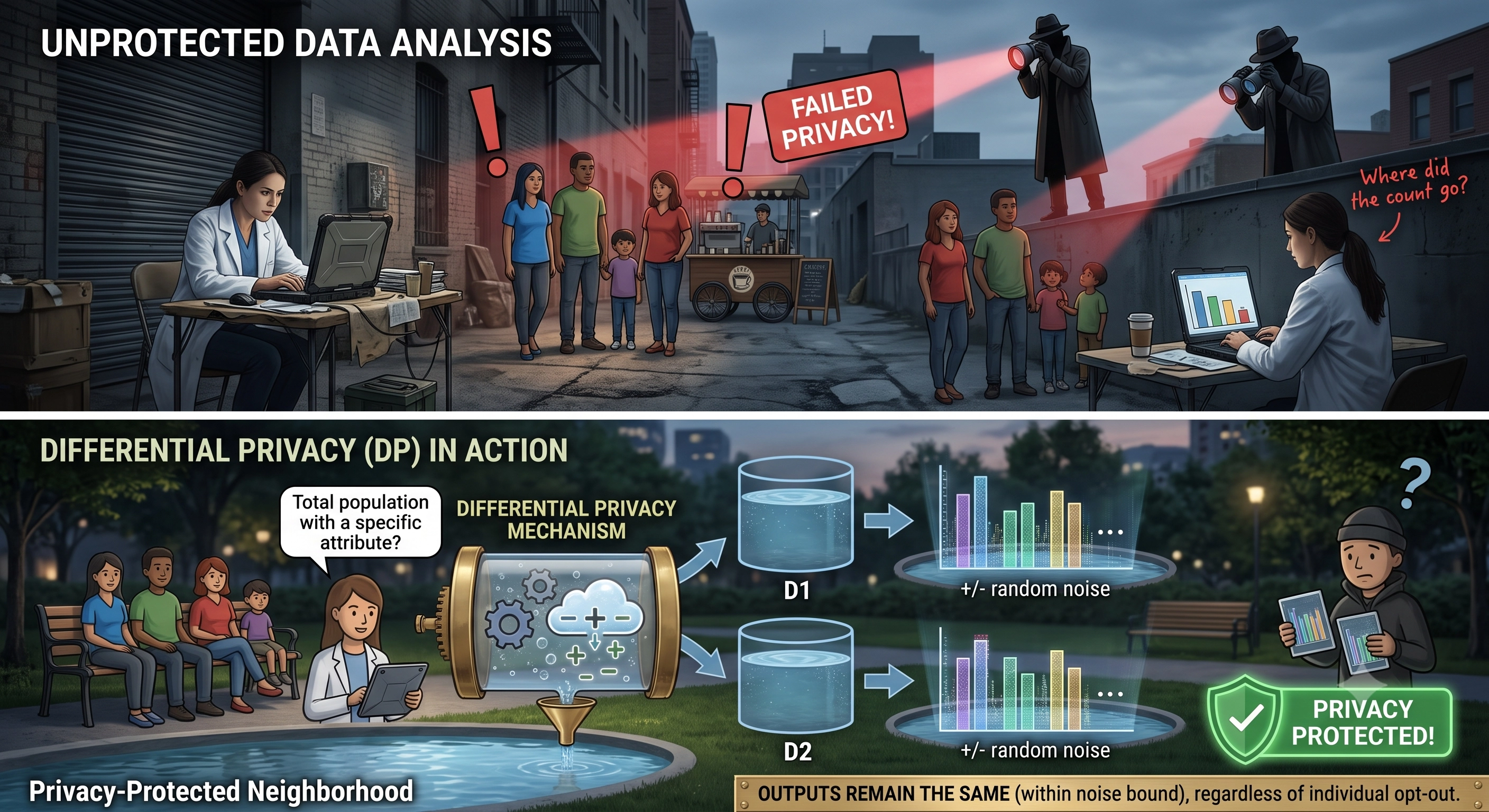
At its core, Differential Privacy is a strong privacy guarantee that ensures that the presence or absence of any single individual's data in a dataset does not significantly affect the outcome of an analysis or query. In simpler terms, if you run a statistical analysis on a dataset, it should be nearly impossible for an observer to tell whether any one person's data was included in that dataset or not.
Think of it like adding a carefully controlled amount of "noise" or randomness to the data before releasing the insights. This noise is just enough to obscure individual contributions, making it difficult to re-identify anyone, but not so much that it distorts the overall statistical patterns and trends.
The "Neighboring Datasets" Concept
A key concept in understanding Differential Privacy is that of "neighboring datasets." Two datasets are considered neighbors if they are identical except for the data of a single individual. A differentially private mechanism ensures that the output of any query or analysis is almost the same, regardless of whether you run it on a dataset D or its neighboring dataset D'. This makes it incredibly difficult to deduce whether a specific person's data was part of the original analysis.
How Does it Work (Simplified)?
Differential Privacy is often implemented by injecting random noise into query results or directly into the data itself. There are two primary approaches:
- Local Differential Privacy: Noise is added to each individual's data before it is collected by an aggregator. This offers stronger individual privacy but can require more noise, potentially reducing accuracy for overall statistics.
- Global Differential Privacy: Noise is added to the aggregated results of a query over the entire dataset. This typically yields more accurate overall results but relies on a trusted aggregator to collect the original, non-private data.
The amount of noise added is controlled by a parameter known as epsilon (ε), also called the "privacy budget." A smaller epsilon value means more noise and thus stronger privacy (less information leakage), but often at the cost of less accurate query results. Conversely, a larger epsilon means less noise, weaker privacy, but more accurate results. Choosing the right epsilon is a critical decision in any differentially private system.
Why is it Important?
- Enhanced Privacy: It provides a quantifiable and robust guarantee against various privacy attacks, including re-identification attempts.
- Enables Data Sharing: Organizations can confidently share aggregated insights or even synthetic datasets with researchers, policymakers, and partners without jeopardizing user privacy.
- Fosters Trust: By offering strong privacy guarantees, it helps build trust with users and comply with strict data protection regulations like GDPR and CCPA.
- Informed Decision Making: It allows for robust statistical analysis and machine learning model training on sensitive data, leading to better products, services, and public policies.
Challenges and Considerations
- Accuracy-Privacy Trade-off: The most significant challenge is balancing the need for strong privacy (small epsilon) with the desire for highly accurate insights (large epsilon).
- Complexity of Implementation: Designing and implementing differentially private algorithms correctly requires specialized expertise and can be mathematically complex.
- Privacy Budget Management: In systems where multiple queries are made over time, managing the accumulated privacy budget (epsilon) is crucial to avoid gradual privacy erosion.
- Real-world Application: Applying differential privacy effectively to diverse and complex real-world datasets can be challenging, especially for high-dimensional data.
Key Takeaways
- Differential Privacy is a mathematically robust framework for analyzing data while preserving individual privacy.
- It works by injecting controlled random noise into data or query results, making it difficult to link insights back to individuals.
- The "epsilon" parameter controls the trade-off between privacy strength and data utility.
- It's crucial for enabling responsible data sharing, fostering trust, and complying with modern privacy regulations.
- While powerful, its implementation involves careful consideration of the privacy-accuracy balance and requires expertise.
Be the first to leave a comment.
Leave a comment