Introduction: Why Rate Limiting Matters
In the world of high-traffic applications and microservices, uncontrolled access can lead to system overload, resource exhaustion, and even denial-of-service (DoS) attacks. Rate limiting is a crucial defensive engineering practice that controls the rate at which users or services can access an API or resource. It ensures fair usage, protects backend infrastructure, and maintains service availability. While many cloud providers and API gateways offer built-in rate limiting, understanding the underlying algorithms empowers you to design more resilient and customized solutions. Today, we'll dive into two fundamental rate limiting algorithms: Token Bucket and Sliding Window Log.
The Token Bucket Algorithm: Allowing for Bursts
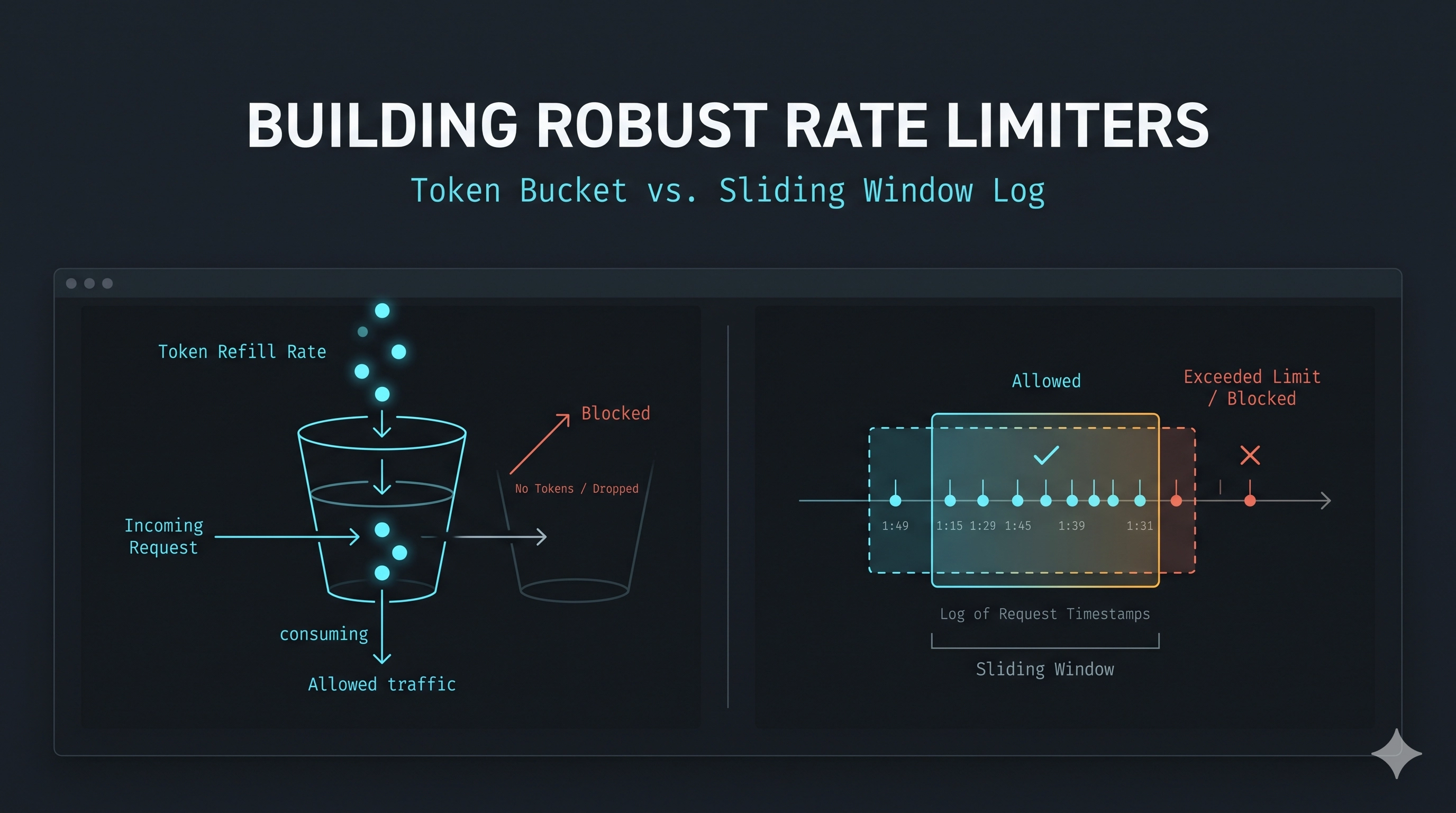
The Token Bucket algorithm is intuitive and widely used. Imagine a bucket that holds a certain number of tokens. These tokens are refilled at a fixed rate. Each time a request arrives, it tries to consume one token from the bucket. If a token is available, the request is processed, and the token is removed. If the bucket is empty, the request is rejected or queued.
Key characteristics:
- Capacity (Bucket Size): The maximum number of tokens the bucket can hold. This determines the maximum burst of requests allowed.
- Refill Rate: The rate at which tokens are added back into the bucket (e.g., 10 tokens per second).
A key advantage of Token Bucket is its ability to handle bursts. If traffic is low, the bucket fills up, allowing a sudden spike in requests to pass through as long as there are enough tokens. This makes it suitable for scenarios where occasional bursts are acceptable without triggering false positives.
Implementation Example (Python)
Here's a basic Python implementation of a Token Bucket rate limiter. We'll track the last refill time to calculate how many tokens have accumulated since then.
import time

class TokenBucketRateLimiter:
    def __init__(self, capacity, refill_rate_per_second):
        self.capacity = capacity
        self.refill_rate = refill_rate_per_second
        self.tokens = capacity
        self.last_refill_time = time.monotonic()

    def _refill(self):
        now = time.monotonic()
        time_elapsed = now - self.last_refill_time
        tokens_to_add = time_elapsed * self.refill_rate
        self.tokens = min(self.capacity, self.tokens + tokens_to_add)
        self.last_refill_time = now

    def allow_request(self, tokens_needed=1):
        self._refill()
        if self.tokens >= tokens_needed:
            self.tokens -= tokens_needed
            return True
        return False

# Example Usage: 10 requests per second, with a burst capacity of 20
limiter = TokenBucketRateLimiter(capacity=20, refill_rate_per_second=10)

print("--- Token Bucket Example ---")
for i in range(25):
    if limiter.allow_request():
        print(f"Request {i+1}: ALLOWED")
    else:
        print(f"Request {i+1}: BLOCKED")
    if i == 4: # Simulate a pause to let the bucket refill
        time.sleep(1.0)
    elif i == 14:
        time.sleep(0.5)
In this code, time.monotonic() provides a monotonically increasing clock, suitable for measuring elapsed time. The _refill method calculates and adds tokens based on the elapsed time and refill rate, ensuring the token count doesn't exceed the capacity. When allow_request is called, it first refills the bucket then checks if enough tokens are present.
The Sliding Window Log Algorithm: Accurate and Granular
The Sliding Window Log algorithm offers a more precise approach to rate limiting, often preferred when strict adherence to the rate limit and minimal burstiness are critical. Instead of tokens, this algorithm keeps a log of timestamps for every request made within a defined time window.
Key characteristics:
- Window Size: The duration over which requests are counted (e.g., 60 seconds).
- Request Limit: The maximum number of requests allowed within the window.
When a request comes in, the algorithm first removes all timestamps from the log that fall outside the current window. Then, it checks if the number of remaining timestamps (i.e., active requests) is less than the allowed limit. If it is, the request is allowed, and its current timestamp is added to the log. Otherwise, the request is rejected.
A significant benefit of Sliding Window Log is its accuracy. It truly enforces a "N requests per M seconds" rule without the potential for bursts that Token Bucket allows. However, it can be memory-intensive, especially for long windows or high request volumes, as it needs to store every request's timestamp.
Implementation Example (Python)
Here's a Python implementation using a simple list as our log. In a production environment, this log would typically be backed by a distributed store like Redis for concurrent and distributed rate limiting.
import time
from collections import deque

class SlidingWindowLogRateLimiter:
    def __init__(self, window_size_seconds, request_limit):
        self.window_size = window_size_seconds
        self.request_limit = request_limit
        self.request_timestamps = deque() # Stores timestamps of allowed requests

    def allow_request(self):
        now = time.monotonic()

        # Remove old timestamps outside the current window
        while self.request_timestamps and \
              self.request_timestamps[0] <= now - self.window_size:
            self.request_timestamps.popleft()

        # Check if current requests exceed the limit
        if len(self.request_timestamps) < self.request_limit:
            self.request_timestamps.append(now)
            return True
        return False

# Example Usage: 5 requests per 10 seconds
limiter = SlidingWindowLogRateLimiter(window_size_seconds=10, request_limit=5)

print("\n--- Sliding Window Log Example ---")
for i in range(15):
    if limiter.allow_request():
        print(f"Request {i+1}: ALLOWED")
    else:
        print(f"Request {i+1}: BLOCKED")
    time.sleep(0.5) # Simulate requests arriving at a steady pace, then a burst
    if i == 5:
        time.sleep(3.0) # Pause to reset window a bit
    if i == 10:
        time.sleep(1.0)
The deque (double-ended queue) is efficient for adding and removing elements from both ends. The allow_request method first prunes old timestamps from the left end of the deque. Then, it checks the length of the remaining timestamps against the request_limit. If within bounds, the current timestamp is added to the right end.
Choosing the Right Algorithm and Production Considerations
Both Token Bucket and Sliding Window Log have their merits and drawbacks:
- Token Bucket:
- Pros: Simpler to implement, more memory-efficient (stores only current tokens and last refill time), allows for request bursts which can be good for user experience.
- Cons: Can be "leaky" if bursts are too large or refill rate is too generous, leading to higher average request rates than intended.
- Sliding Window Log:
- Pros: Extremely accurate, strictly enforces rate limits without significant burst allowance, provides a clear view of request history within the window.
- Cons: Can be very memory-intensive, especially for large window sizes or high request rates, as it stores a timestamp for every allowed request. Its performance degrades as the number of logged requests increases.
For distributed systems, a single in-memory instance of these limiters is insufficient. You'd typically use a centralized store like Redis. For Token Bucket, Redis can store the tokens count and last_refill_time. For Sliding Window Log, Redis Sorted Sets (ZSET) are ideal for storing timestamps, allowing efficient range queries and removals.
Pro Tip: Hybrid Approaches
Many advanced rate limiters use hybrid approaches. For example, combining a Token Bucket for immediate throttling with a Sliding Window Counter (which only stores counts per interval, not individual timestamps) for long-term rate limiting offers a balance of burst handling and accuracy without the memory overhead of a full log.
When deploying rate limiting, consider:
- Granularity: Per IP, per user, per API endpoint, or global?
- Action on Exceedance: Reject (HTTP 429 Too Many Requests), queue, or degrade service?
- Distributed Consistency: How do multiple instances of your service coordinate their rate limits? (Redis is key here).
- Edge Cases: What if a user rapidly cycles through IPs? How do you handle bot traffic vs. legitimate users?
Key Takeaways
- Rate limiting is essential for system resilience, preventing abuse, and ensuring fair resource allocation.
- The Token Bucket algorithm is simple, allows for bursts, and is memory-efficient. Ideal for forgiving limits where occasional spikes are acceptable.
- The Sliding Window Log algorithm offers precise rate enforcement, preventing bursts but can be memory-intensive due to storing individual request timestamps. Ideal for strict limits where accuracy is paramount.
- For distributed systems, a centralized data store like Redis is critical for synchronized rate limiting across multiple service instances.
- Consider hybrid approaches and different granularity levels to build robust and scalable rate limiting solutions.
Be the first to leave a comment.
Leave a comment