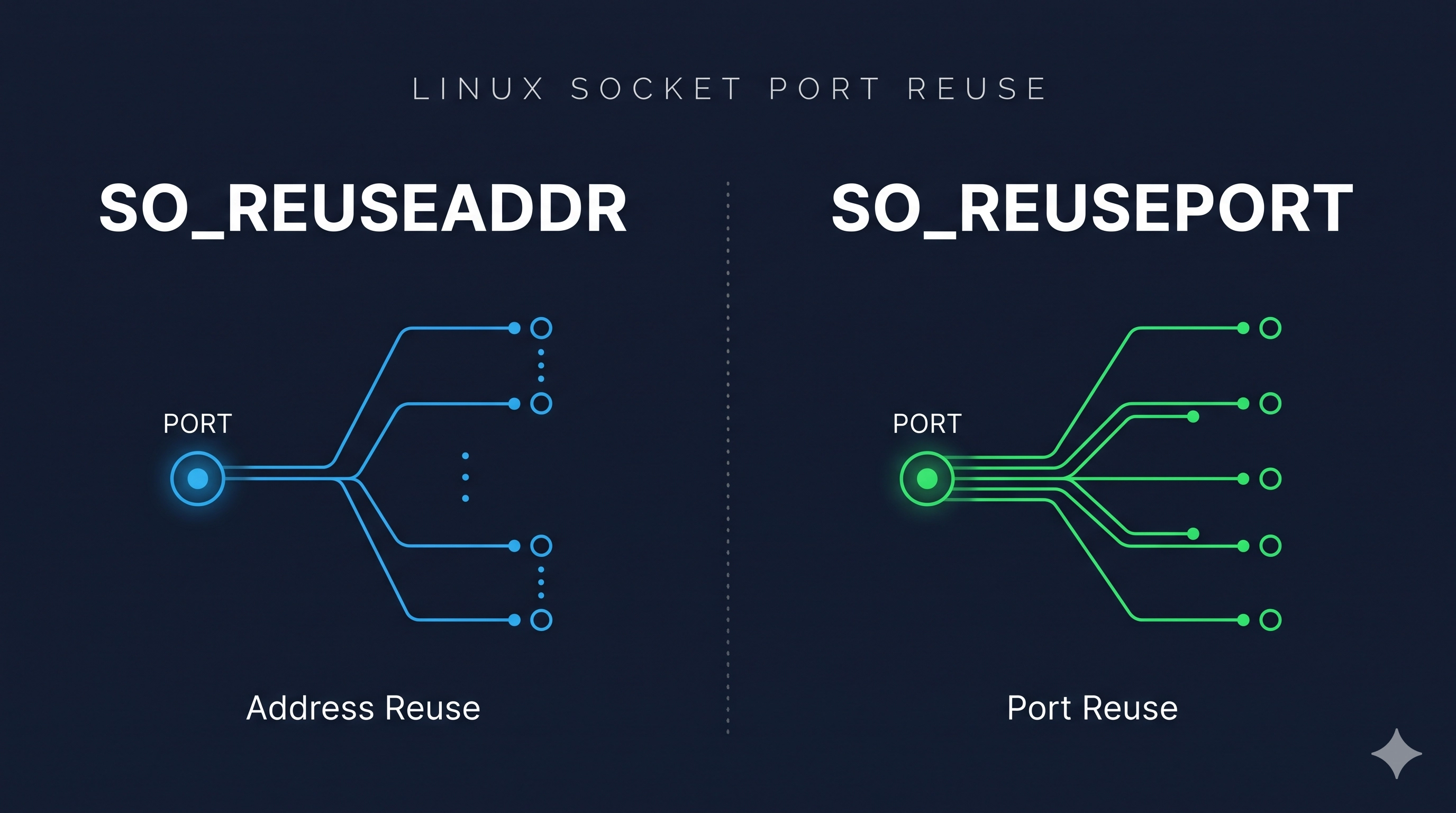
The 'Address Already In Use' Headache
As systems engineers, few messages are as frustrating during a critical deployment or service restart as Address already in use. In a world demanding high availability and seamless updates, having a server process fail to bind to its intended port because a previous instance lingered, or because another process unexpectedly occupies it, is simply unacceptable. This common operational challenge often leads us to explore socket options that grant greater control over port binding. On Linux, two powerful but often misunderstood options stand out: SO_REUSEADDR and SO_REUSEPORT.
While both aim to enable port reuse, their mechanisms, implications, and ideal use cases differ significantly. Understanding these distinctions is crucial for designing robust, high-performance network services capable of zero-downtime deployments and efficient resource utilization.
SO_REUSEADDR: The Restart Ally
SO_REUSEADDR is arguably the more well-known of the two, primarily addressing scenarios involving quick service restarts and dealing with TCP's lingering TIME_WAIT state. When a TCP connection is closed, the side that initiates the active close (typically the client, but can be the server) enters the TIME_WAIT state for a period (usually 2 * MSL - Maximum Segment Lifetime, often 60-120 seconds). During this time, the local port is technically still 'in use' by the operating system to ensure any delayed packets for that connection are properly handled.
Without SO_REUSEADDR, attempting to bind a new socket to a port still in TIME_WAIT state will result in an Address already in use error. Setting SO_REUSEADDR allows your server to bind to that port immediately, even if it's in TIME_WAIT, effectively cutting down downtime during restarts.
How it Works:
- Reuse of TIME_WAIT ports: Allows a new socket to bind to a port that is still in the
TIME_WAITstate from a previous connection. - Flexibility with IP addresses: Permits multiple sockets to bind to the same port IF they bind to different local IP addresses (e.g., one to
192.168.1.1:80and another to192.168.1.2:80). - Wildcard binding: If one socket binds to
0.0.0.0:PORT(INADDR_ANY) withSO_REUSEADDRset, and another binds to a specific IP like192.168.1.1:PORT, the specific IP binding takes precedence for connections directed to that IP, while theINADDR_ANYsocket catches the rest.
Pros:
- Facilitates quick restarts: Prevents 'Address already in use' errors due to lingering
TIME_WAITstates. - Simplicity: Relatively straightforward to implement and understand for basic restart scenarios.
Cons:
- Security Risk (Potential Port Hijacking): If a server binds to
INADDR_ANYwithSO_REUSEADDR, another process (potentially malicious) can bind to the same port on a specific IP address *before* the intended server, effectively intercepting traffic directed to that specific IP. However, if the intended server binds first, a malicious process cannot steal theINADDR_ANYbinding. - No True Load Balancing: Does not allow multiple processes to *actively listen* on the exact same specific IP:port combination to load balance incoming connections. Only one socket can be the 'active' listener for a given local IP:port.
Example: Setting SO_REUSEADDR in Python
import socket
import os

HOST = '0.0.0.0'
PORT = 8080

def start_server_reuseaddr():
    s = socket.socket(socket.AF_INET, socket.SOCK_STREAM)
    s.setsockopt(socket.SOL_SOCKET, socket.SO_REUSEADDR, 1) # Set SO_REUSEADDR
    s.bind((HOST, PORT))
    s.listen(5)
    print(f"Process {os.getpid()} (SO_REUSEADDR) listening on {HOST}:{PORT}")
    conn, addr = s.accept() # Example: just accept one connection
    print(f"Connection from {addr}")
    conn.close()
    s.close()
    print(f"Process {os.getpid()} finished.")

if __name__ == "__main__":
    start_server_reuseaddr()
SO_REUSEPORT: The Load Balancing Maestro
Introduced in Linux kernel 3.9, SO_REUSEPORT dramatically changes how multiple processes can listen on the same port. Unlike SO_REUSEADDR, which primarily deals with TIME_WAIT states and varying IP bindings, SO_REUSEPORT allows multiple *independent sockets* to bind to the *exact same local IP address and port combination*. The Linux kernel then intelligently distributes incoming connections among these listening sockets.
This is a game-changer for high-performance network services that need to scale horizontally on a single machine, such as Nginx worker processes, multiple Go application instances, or Node.js cluster workers. It effectively offloads connection distribution from an application-level proxy to the kernel, potentially reducing latency and improving throughput.
How it Works:
- Multiple identical bindings: Allows multiple processes/sockets to bind to
IP:PORTwhere IP and PORT are identical across all binders. - Kernel-level load balancing: The kernel uses a hash function based on the connection's source IP, source port, destination IP, and destination port to deterministically choose one of the listening sockets for each new incoming connection. This ensures an even distribution and avoids thundering herd problems.
- Security enforcement: All processes binding to the same
IP:PORTwithSO_REUSEPORTmust have the same effective user ID. This prevents unauthorized processes from intercepting traffic.
Pros:
- True Kernel-level Load Balancing: Efficiently distributes incoming connections across multiple worker processes/threads without an external load balancer or application-level routing.
- Seamless Zero-Downtime Deployments: Enables rolling upgrades where old service instances can gracefully drain existing connections while new instances immediately begin accepting new traffic on the same port.
- Improved Performance: Reduces contention and context switching overhead compared to a single process accepting all connections and then handing them off.
- Enhanced Resource Utilization: Better leverages multi-core CPUs for network I/O.
Cons:
- Kernel Version Requirement: Requires Linux kernel 3.9 or newer (which is generally not an issue for modern deployments, but worth noting).
- Application State Management: If your application maintains per-process state, you'll need a strategy for managing this across multiple instances receiving connections concurrently.
- Complexity for Debugging: Can be slightly more complex to trace which specific process handled a particular connection if not properly logged.
Example: Setting SO_REUSEPORT in Python
import socket
import os
import sys

HOST = '0.0.0.0'
PORT = 8081 # Use a different port to avoid conflict if testing both

def start_server_reuseport():
    s = socket.socket(socket.AF_INET, socket.SOCK_STREAM)
    s.setsockopt(socket.SOL_SOCKET, socket.SO_REUSEADDR, 1) # Often used alongside for TIME_WAIT
    s.setsockopt(socket.SOL_SOCKET, socket.SO_REUSEPORT, 1) # Set SO_REUSEPORT
    s.bind((HOST, PORT))
    s.listen(5)
    print(f"Process {os.getpid()} (SO_REUSEPORT) listening on {HOST}:{PORT}")
    try:
        while True:
            conn, addr = s.accept()
            print(f"Process {os.getpid()} received connection from {addr}")
            conn.sendall(f"Hello from process {os.getpid()}\n".encode())
            conn.close()
    except KeyboardInterrupt:
        print(f"Process {os.getpid()} shutting down.")
    finally:
        s.close()

if __name__ == "__main__":
    # To test this, you would run this script multiple times in separate terminals:
    # python your_script.py & python your_script.py &
    # Then connect using `nc 127.0.0.1 8081` multiple times
    start_server_reuseport()
Architectural Comparison and Decision Framework
Here's a breakdown to help you decide which option (or combination) fits your architectural needs:
| Feature | SO_REUSEADDR | SO_REUSEPORT |
|---|---|---|
| Primary Purpose | Facilitate quick service restarts by reusing TIME_WAIT ports. | Enable kernel-level load balancing across multiple identical listeners on the same IP:port. |
| Binding Behavior | Allows binding to a port in TIME_WAIT. Allows multiple binders only if different IPs or wildcard INADDR_ANY is used with specific IPs. | Allows multiple *identical* bindings (same IP:port) by different processes. |
| Connection Distribution | No kernel-level distribution; only one active listener per IP:port. | Kernel distributes incoming connections evenly among listening sockets using a hash function. |
| Zero-Downtime Deployment | Aids quick restarts but doesn't inherently support seamless switchover of active connections. | Excellent for zero-downtime rolling upgrades; new processes start listening immediately alongside old ones. |
| Security Considerations | Potential for a rogue process to hijack a specific IP binding if it binds first. | Requires same effective user ID for all binders to prevent unauthorized access. |
| Kernel Requirement | Available on all modern Linux kernels. | Linux kernel 3.9+ (introduced 2013). |
When to Choose SO_REUSEADDR:
- You need to quickly restart a single-instance service without waiting for
TIME_WAITsockets to clear. - Your service binds to
0.0.0.0and you want to ensure it can restart even if some specific IP connections are still inTIME_WAIT. - You are running an older Linux kernel (pre-3.9) and
SO_REUSEPORTis not available. - You are NOT trying to achieve kernel-level load balancing across multiple identical processes on the same IP:port.
When to Choose SO_REUSEPORT:
- You are building a high-performance network service that needs to scale horizontally across multiple CPU cores on a single host.
- You want to implement truly seamless zero-downtime deployments without relying on an external proxy or complex application-level logic for connection draining.
- You need kernel-level load balancing to distribute incoming connections directly to your worker processes/threads, reducing latency and maximizing throughput.
- Your application processes are largely stateless or can manage shared state effectively.
- You are on Linux kernel 3.9 or newer.
Can They Be Used Together?
Yes, SO_REUSEADDR and SO_REUSEPORT are often used in conjunction. SO_REUSEADDR ensures that even if old connections are in TIME_WAIT state, new SO_REUSEPORT listeners can still bind immediately. This is particularly useful during rolling deployments where you might have old processes shutting down and new ones spinning up, both trying to bind to the same port.
Production Lessons and Failure Modes
- Misunderstanding
SO_REUSEADDR's Scope: A common misconception is thatSO_REUSEADDRallows multiple processes to *actively listen* on the sameIP:PORTfor load balancing. It does not. Its primary role is to enable binding when the port is inTIME_WAITor to allow multiple binds on *different* IPs. SO_REUSEPORTSecurity: Remember the user ID requirement forSO_REUSEPORT. If you try to bind multiple processes under different user IDs, the subsequent binds will fail with an 'Address already in use' error or a permission denied error. This is a deliberate security feature.- Application State with
SO_REUSEPORT: If your service relies on maintaining state per connection or per process, be extremely careful when usingSO_REUSEPORT. Since connections are distributed by the kernel, you can't guarantee a specific client will always hit the same process unless you implement sticky sessions at a higher layer. This is whySO_REUSEPORTshines with stateless worker models. - Debugging
SO_REUSEPORTDistribution: When usingSO_REUSEPORT, it can sometimes be tricky to debug connection distribution. Tools likess -lnptucan show all processes listening on a port, and you can add logging to each worker process to confirm which one is handling incoming connections. - Operating System Variations: While the concepts are similar, the exact behavior and availability of these options can vary slightly across different Unix-like operating systems (e.g., macOS, FreeBSD). Always consult your OS's documentation if developing cross-platform.
Key Takeaways
SO_REUSEADDRprimarily facilitates quick service restarts by allowing binding to ports inTIME_WAITstate. It does not enable true kernel-level load balancing for multiple processes on the same exact IP:port.SO_REUSEPORT(Linux 3.9+) is the solution for kernel-level load balancing, allowing multiple processes to bind to the identical IP:port and share incoming connections efficiently. It's ideal for scalable, zero-downtime deployments.- For robust high-availability services on modern Linux, using both
SO_REUSEADDRandSO_REUSEPORTis often the optimal strategy, combining quick restart capabilities with efficient kernel-level connection distribution. - Always consider the security implications (user IDs for
SO_REUSEPORT, binding order forSO_REUSEADDRwithINADDR_ANY) and how your application handles state when choosing between or combining these powerful socket options.
Be the first to leave a comment.
Leave a comment