Matter Protocol: Unifying the Smart Home
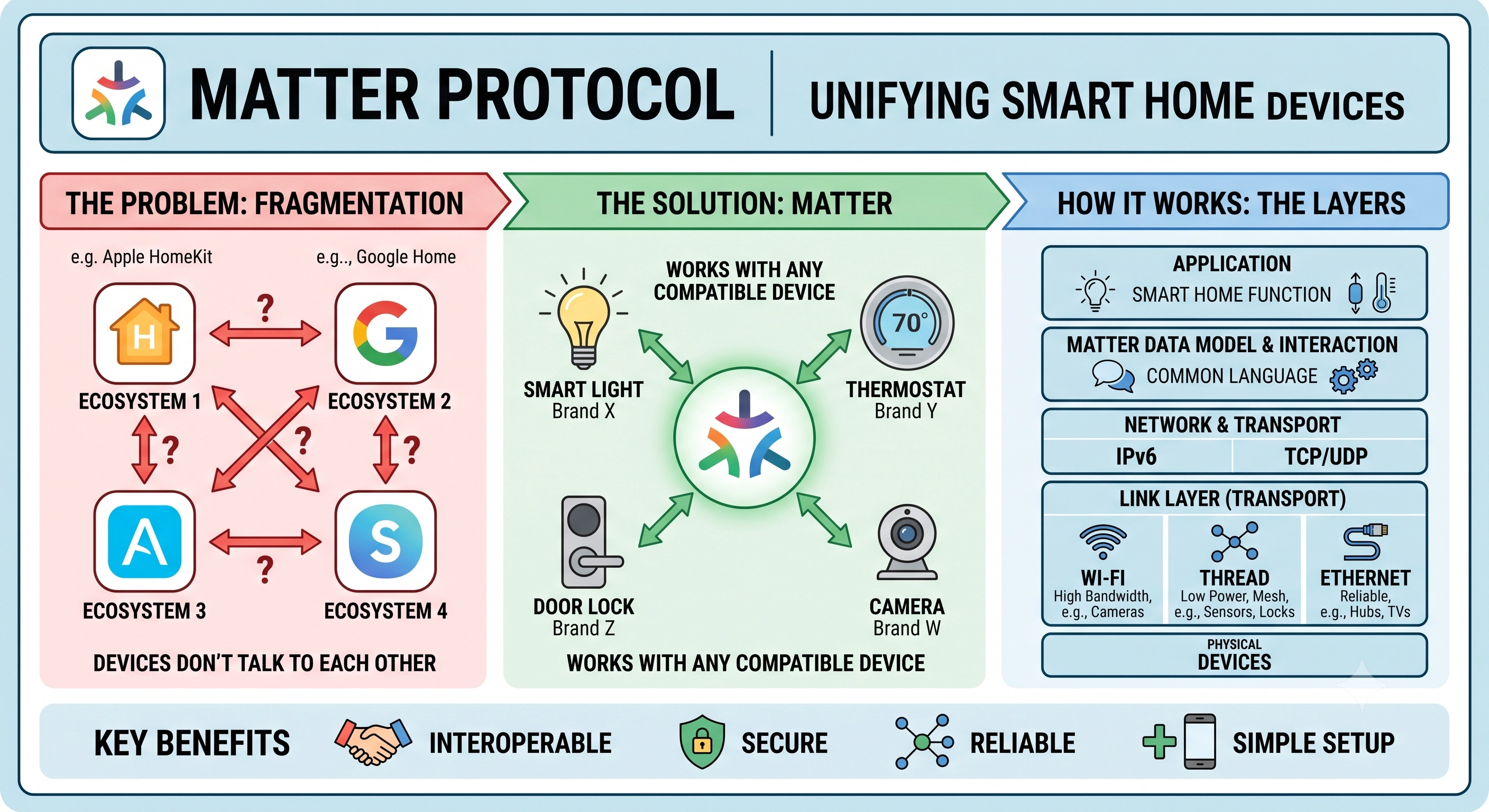
For years, setting up a smart home felt like navigating a technological maze. You'd buy a smart bulb from one brand, a thermostat from another, and a smart lock from a third, only to find they didn't speak the same language. Each device often required its own app, its own hub, and its own set of rules, leading to frustration and a fragmented user experience. But what if there was a universal language, a standard that all smart home devices could understand? Enter Matter.
What is Matter?
Matter is an open-source connectivity standard for smart home devices, developed by the Connectivity Standards Alliance (CSA). This alliance includes hundreds of companies, from tech giants like Apple, Google, Amazon, and Samsung to major smart home manufacturers. Its primary goal is to provide a unified, reliable, and secure way for smart home devices to communicate with each other, regardless of brand or ecosystem.
Think of Matter as a universal translator for your smart home. Instead of each device speaking a different dialect (like Zigbee, Z-Wave, Wi-Fi, or Bluetooth Low Energy, often requiring a proprietary hub to bridge them), Matter creates a common communication layer built on familiar IP (Internet Protocol) technologies. This means devices can talk to each other directly over your existing home network.
How Does Matter Work?
Matter leverages proven IP-based networking technologies such as Wi-Fi, Thread, and Ethernet. Wi-Fi provides high bandwidth for devices like smart cameras, while Thread creates a robust, self-healing mesh network for lower-bandwidth devices like smart lights and sensors. Bluetooth Low Energy (BLE) is used primarily for initial device setup (commissioning).
Key aspects of Matter's operation include:
- Local Control: Many Matter-enabled devices can operate locally within your home network, reducing reliance on cloud services and improving responsiveness.
- Interoperability: A Matter-certified device can work with any Matter-certified controller or platform (e.g., Apple Home, Google Home, Amazon Alexa, Samsung SmartThings).
- Security: Matter incorporates robust security features, including device authentication and secure communication, protecting your home from unauthorized access.
- Simplicity: Pairing new devices is streamlined. A single QR code scan or tap can add a device to your preferred smart home ecosystem, eliminating the need for multiple apps or complex configurations.
Benefits for Users and Manufacturers
For Users:
- Unprecedented Compatibility: Buy any Matter-certified device and be confident it will work with your existing smart home system.
- Easier Setup: Forget juggling multiple apps. A single setup process links new devices to your chosen ecosystem.
- Improved Reliability: Local control and the mesh networking capabilities of Thread often lead to faster, more stable device responses.
- Enhanced Security: Stronger, standardized security protocols offer greater peace of mind.
For Manufacturers and Developers:
- Simplified Development: Focus on innovation rather than building separate integrations for every major platform.
- Wider Market Reach: Devices instantly become compatible with a vast ecosystem of smart homes, increasing potential sales.
- Future-Proofing: As an open standard, Matter is designed to evolve, ensuring long-term relevance.
Current Status and Challenges
Matter launched its first specification in late 2022, and devices are steadily rolling out. We're seeing software updates enabling Matter on existing devices, as well as new products coming to market. However, it's not a magic bullet:
- Adoption Curve: It will take time for all existing devices to receive updates (if possible) and for new Matter-native devices to dominate the market.
- Feature Parity: While core functions are standardized, some advanced, brand-specific features might still require the manufacturer's app.
- Not a Replacement for Apps: You'll still use your preferred smart home app (e.g., Apple Home, Google Home) to control and automate your devices, but Matter ensures the devices themselves communicate effectively.
Key Takeaways
- Matter is an open-source standard for smart home device interoperability.
- It aims to solve smart home fragmentation by enabling devices to "speak" a common language over IP.
- Benefits include easier setup, broad compatibility, local control, and enhanced security.
- While adoption is ongoing, Matter represents a significant step towards a truly unified and user-friendly smart home experience.
The journey to a perfectly seamless smart home continues, but with Matter, we're finally on a clear path towards a future where your smart devices just... work, together.
Be the first to leave a comment.
Leave a comment