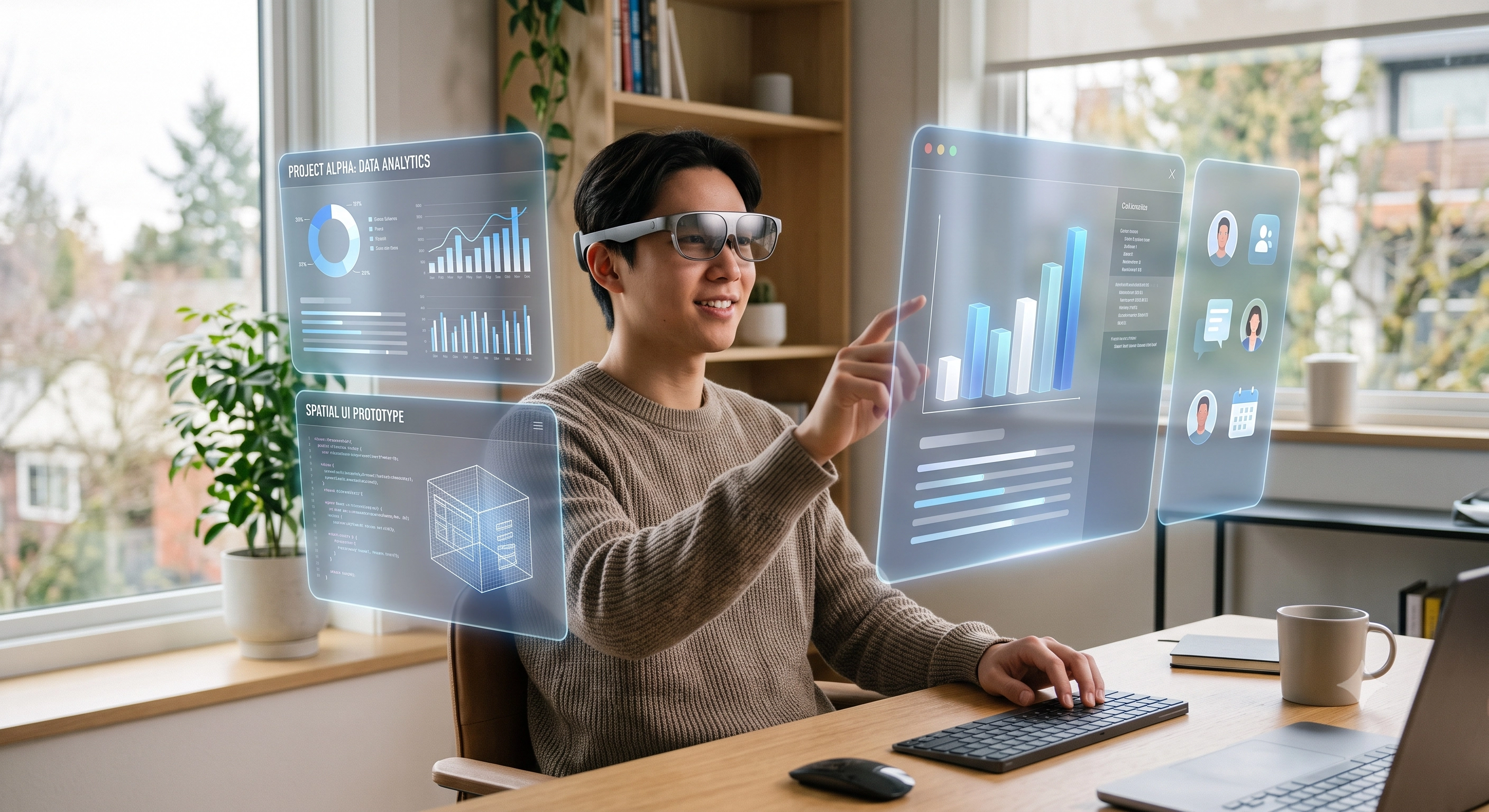
Spatial Computing: Blurring the Lines Between Digital and Physical
For decades, our interaction with computers has largely been confined to a 2D screen – a window into a separate digital world. But what if that digital world could seamlessly merge with our physical surroundings? Welcome to the era of Spatial Computing, a paradigm shift that promises to transform how we perceive and interact with technology and the world around us.
What is Spatial Computing?
Spatial Computing is an umbrella term referring to technology that allows humans to interact with machines in a three-dimensional space. Unlike traditional computing, which often requires us to interpret information from a flat screen, spatial computing overlays digital information onto our real-world environment or creates fully immersive digital worlds, letting us manipulate virtual objects and interact with data as if they were physically present.
Think beyond just Virtual Reality (VR) or Augmented Reality (AR). While these are components, spatial computing aims for a more profound integration. It's about:
- Understanding the environment: Devices equipped with advanced sensors (cameras, LiDAR, depth sensors) map and understand the physical space around the user.
- Placing digital content contextually: Virtual objects and information aren't just projected; they are aware of and interact with the physical world, adhering to real-world physics and occlusion.
- Natural interaction: Users interact with digital content using intuitive gestures, gaze, voice, and even walking around, rather than just a mouse and keyboard.
Key Components of Spatial Computing
Achieving this seamless blend requires a sophisticated interplay of various technologies:
- Advanced Hardware: Headsets (like Apple Vision Pro, Meta Quest), smart glasses, and even smartphones with powerful processors, high-resolution displays, and an array of sensors are crucial.
- Robust Software Platforms: Operating systems and development frameworks designed to handle 3D environments, spatial mapping, object recognition, and real-time rendering.
- AI and Machine Learning: Essential for interpreting sensor data, understanding user intent, predicting interactions, and creating intelligent, responsive digital content.
- 3D Content Creation Tools: Tools for designing and modeling virtual objects, environments, and experiences.
Applications Across Industries
The potential applications of spatial computing are vast and truly transformative:
- Design & Engineering: Architects can walk through their building designs before construction, engineers can collaborate on 3D models of complex machinery, and designers can prototype products virtually.
- Education & Training: Immersive learning experiences can transport students to historical sites, inside the human body, or allow hands-on training for complex procedures in a safe, virtual environment.
- Healthcare: Surgeons can practice intricate operations, medical students can explore anatomical models, and patients could receive guided rehabilitation exercises.
- Entertainment & Gaming: Step inside games, watch movies where characters interact with your living room, or attend virtual concerts with a sense of presence.
- Work & Collaboration: Remote teams can meet in virtual spaces, share 3D models, and collaborate on projects as if they were in the same room.
Challenges and the Road Ahead
While the promise is immense, spatial computing faces challenges:
- Hardware Limitations: Current devices can be bulky, expensive, and have limited battery life.
- User Comfort: Extended use can sometimes lead to motion sickness or fatigue.
- Data Privacy & Security: Mapping physical environments and tracking user movements raise significant privacy concerns.
- Content Creation: Developing compelling and rich 3D spatial experiences is complex and resource-intensive.
- Interoperability: Ensuring different platforms and devices can seamlessly share spatial data and experiences.
Despite these hurdles, the trajectory is clear. As hardware becomes lighter and more powerful, software more intelligent, and development tools more accessible, spatial computing will increasingly blend into our daily lives, fundamentally altering our relationship with digital information.
Key Takeaways
- Spatial Computing merges digital content with our physical world, going beyond traditional screens.
- It relies on advanced hardware, intelligent software, and AI to understand and interact with 3D space.
- Applications span design, education, healthcare, entertainment, and collaborative work.
- Challenges include hardware limitations, user comfort, and privacy, but the field is rapidly evolving.
Be the first to leave a comment.
Leave a comment