Decentralized Social Media: Taking Back Control of Your Digital Conversations
In an age dominated by vast centralized social networks, a growing movement seeks to shift the power back to the users. This movement champions decentralized social media, offering a fundamentally different way to connect online.
For years, we've entrusted our digital lives to a handful of massive platforms. While convenient, this comes with significant trade-offs: concerns over data privacy, algorithmic manipulation, and the potential for unilateral censorship. But what if there was another way? What if you could participate in a social network that you, or your community, truly owned?
What is Decentralized Social Media?
Unlike traditional platforms where a single company owns all the servers, data, and decision-making, decentralized social media distributes these functions across many independent servers, often operated by various individuals or organizations. Think of it less like a single monolithic building, and more like a collection of many small, interconnected houses.
These individual servers (often called "instances" or "nodes") can communicate with each other, forming a vast, federated network. This architecture means there's no single point of control – or failure. If one server goes down, the rest of the network continues to operate.
The Power of ActivityPub
At the heart of many decentralized social networks is a protocol called ActivityPub. This open standard allows different social applications to talk to each other, enabling seamless communication across various platforms. It's like a universal language that lets diverse social media "islands" become a connected "archipelago."
Thanks to ActivityPub, you might have an account on one platform, but you can still follow and interact with users on another ActivityPub-compatible platform. This interoperability is a game-changer, breaking down the walled gardens of proprietary social networks.
Mastodon: A Prime Example
Perhaps the most well-known example of decentralized social media is Mastodon. Launched in 2016, Mastodon functions similarly to Twitter but operates on a federated model.
- Instances: Users choose an "instance" (a server) to join. Each instance has its own rules, moderation policies, and community focus.
- Federation: While each instance is independent, they can "federate" (connect) with other instances. This allows users on different instances to follow each other, share content, and engage in conversations.
- User Control: You're not beholden to a single corporate entity. If you dislike your current instance, you can migrate your account and followers to another.
This model fosters diverse, niche communities that are self-governing, rather than being dictated by a centralized authority.
Key Benefits and Challenges
Benefits:
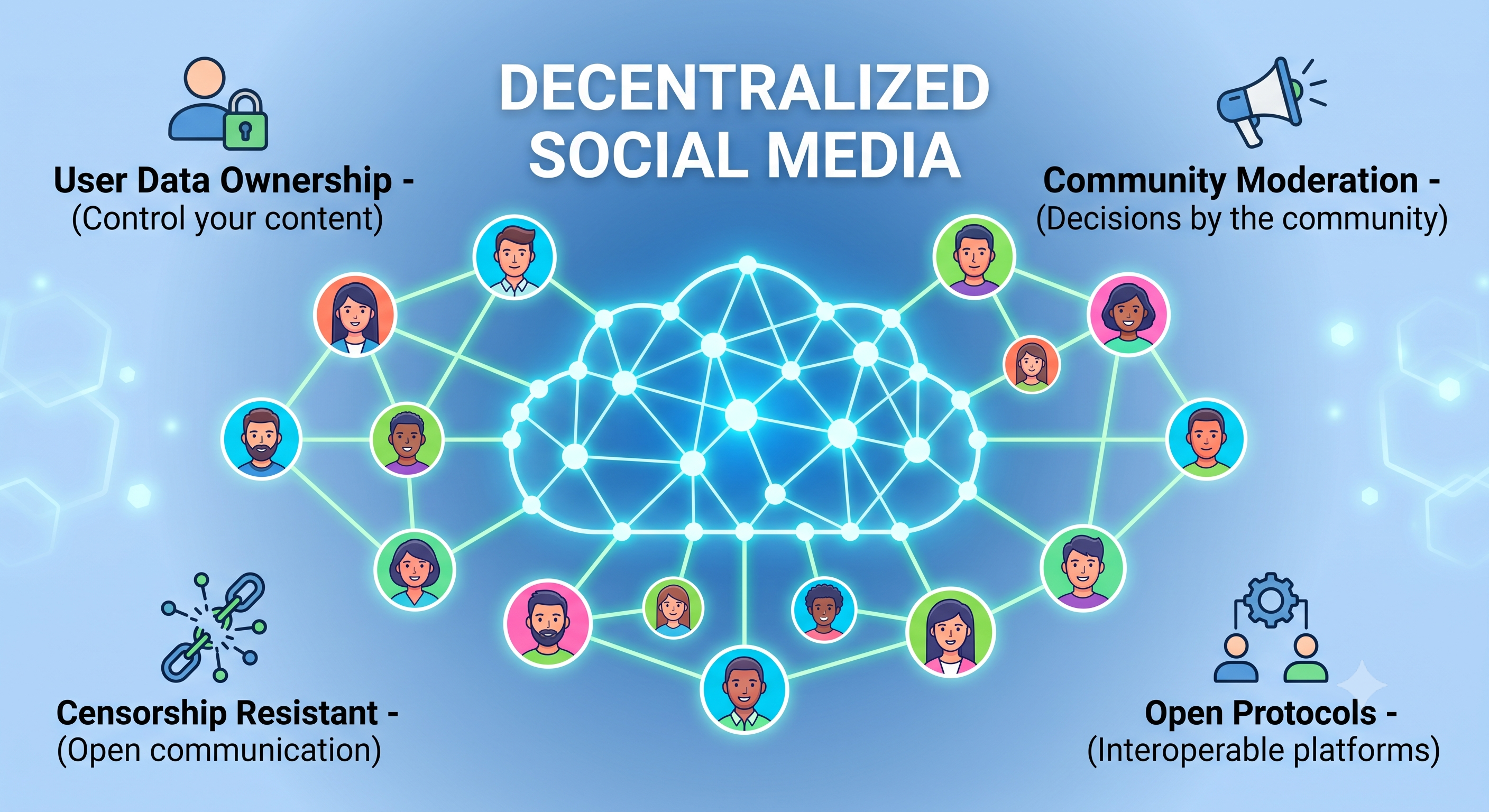
- User Empowerment: Greater control over your data and online experience.
- Censorship Resistance: No single entity can unilaterally remove content or ban users across the entire network.
- Privacy-Focused: Many instances prioritize user privacy, often with no ads or tracking.
- Community Driven: Fosters smaller, more focused communities with shared interests and values.
Challenges:
- Learning Curve: Understanding instances, federation, and different moderation styles can take time.
- Discoverability: Finding new users or communities might be less straightforward than on massive centralized platforms.
- Scalability & Moderation: Ensuring consistent moderation and combating abuse across a vast, distributed network can be complex.
Key Takeaways
Decentralized social media represents a paradigm shift, moving from corporate-owned platforms to user-owned and community-governed networks. While still maturing, platforms like Mastodon, powered by protocols like ActivityPub, offer a compelling vision for a more private, controllable, and democratic digital future. It's about choosing where and how you connect, rather than being confined to a single digital landlord.
Nếu vậy thì sao mà để thông tin cập nhật được nhiều hơn mạng xã hội tập trung?