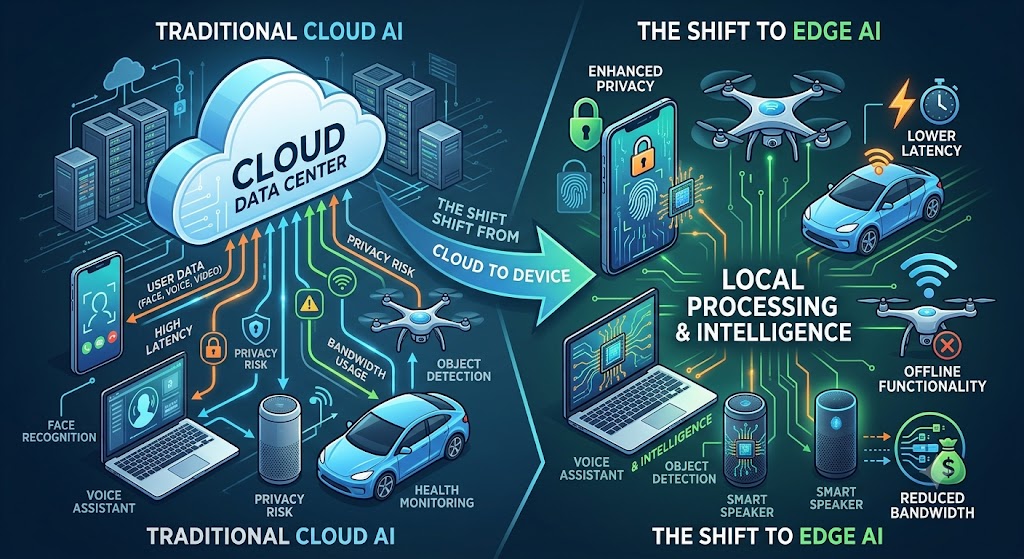
The Shift from Cloud to Device
Artificial Intelligence (AI) has become an integral part of our daily lives, powering everything from search engines to recommendation systems. Traditionally, much of this AI processing happened in the cloud—massive data centers far away from the user. However, a significant shift is underway: AI is moving to the "edge"—directly onto our devices.
What Exactly is Edge AI?
Edge AI refers to the practice of performing AI computations locally on a device, rather than sending data to a central cloud server for analysis. Imagine your smartphone recognizing your face, a smart speaker understanding your voice command, or an autonomous car detecting pedestrians, all without needing to send that data over the internet to a remote server. That's Edge AI in action.
Why is Edge AI Gaining Traction?
Several compelling reasons are driving this decentralization of AI:
- Enhanced Privacy: Data, especially sensitive personal information, remains on the device, reducing the risk of breaches during transmission or storage in the cloud.
- Lower Latency: Processing happens instantly on the device, eliminating network delays. This is critical for applications like autonomous driving where real-time decisions are paramount.
- Reduced Bandwidth & Cost: Less data needs to be uploaded to the cloud, saving bandwidth and lowering operational costs for service providers.
- Offline Functionality: Devices can perform AI tasks even without an internet connection, ensuring continuous operation in remote areas or during network outages.
- Increased Reliability: Less reliance on continuous cloud connectivity makes devices more robust and dependable.
Key Applications of Edge AI
Edge AI is already transforming various sectors:
- Smartphones: On-device image processing (e.g., portrait mode, scene recognition), voice assistants, predictive text, and facial recognition.
- Smart Homes: Local processing for security cameras (identifying people vs. pets), smart speakers (voice command recognition), and thermostats for faster reactions and better privacy.
- Autonomous Vehicles: Real-time object detection, path planning, and decision-making directly on the vehicle for maximum safety.
- Industrial IoT: Predictive maintenance on factory floors, quality control, and anomaly detection without sending sensitive operational data off-site.
- Wearables: Continuous health monitoring, activity tracking, and gesture recognition with extended battery life.
Challenges on the Edge
Despite its advantages, Edge AI comes with its own set of hurdles:
- Resource Constraints: Edge devices often have limited processing power, memory, and battery life, requiring highly optimized AI models.
- Model Optimization: Developing smaller, more efficient AI models that can run effectively on constrained hardware without sacrificing accuracy.
- Security: Protecting on-device models and data from tampering or unauthorized access.
- Updates and Maintenance: Managing and deploying model updates across a vast number of edge devices can be complex.
Key Takeaways
Edge AI represents a fundamental shift in how we build and interact with smart technology. It promises:
- Greater Privacy: Your data stays with you.
- Blazing Speed: Instant responses without cloud lag.
- Cost Efficiency: Reduced reliance on expensive cloud infrastructure.
- New Possibilities: Enabling smarter, more reliable, and context-aware applications directly on devices.
As hardware becomes more capable and AI models more efficient, Edge AI is set to redefine our digital experiences, making our devices not just smart, but truly intelligent and independent.
Be the first to leave a comment.
Leave a comment