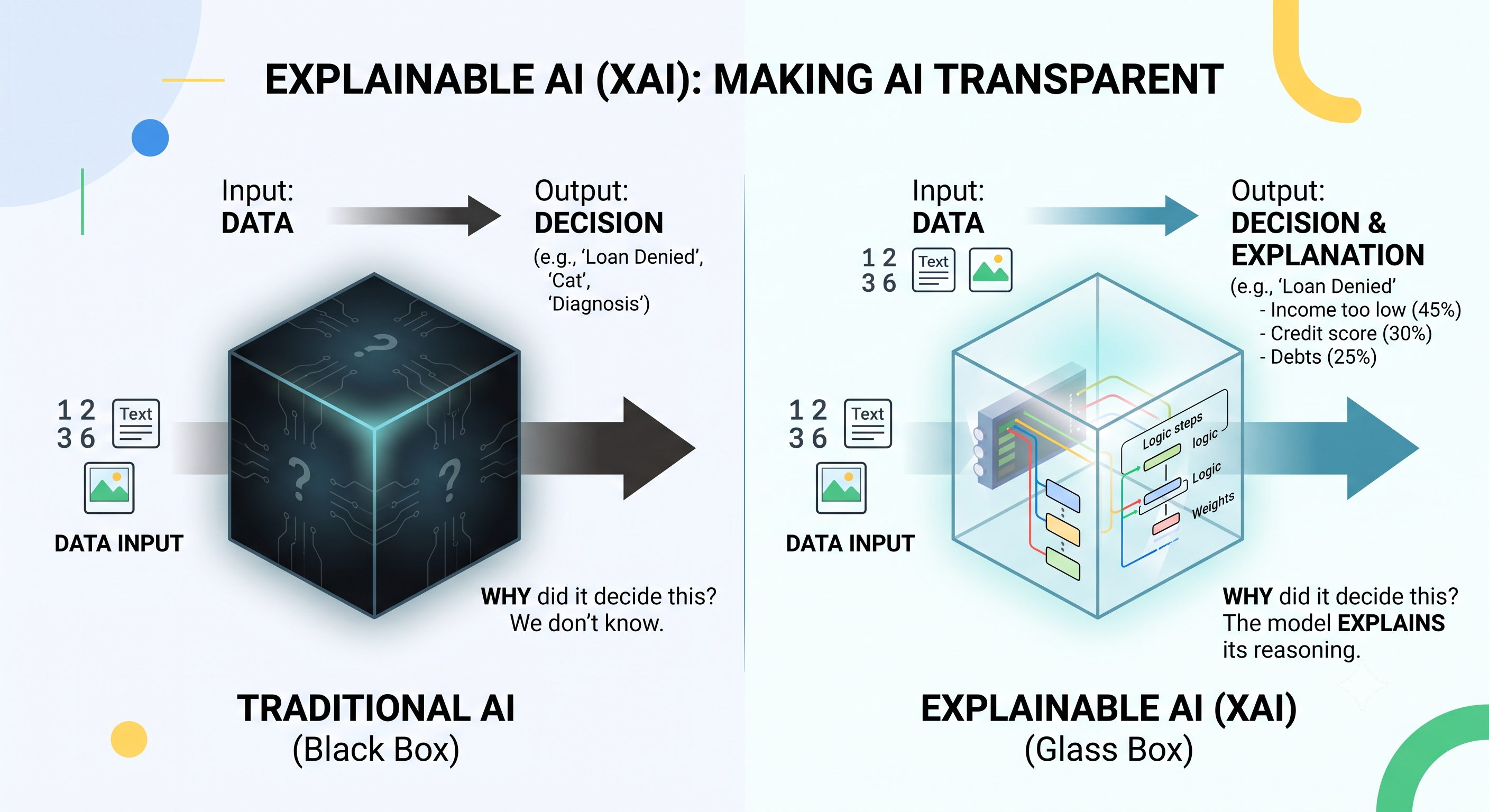
Explainable AI (XAI): Unlocking the Black Box of Artificial Intelligence
Artificial Intelligence (AI) has become an integral part of our daily lives, from personalized recommendations to medical diagnostics and autonomous vehicles. While AI's capabilities continue to astound us, a significant challenge remains: understanding how these intelligent systems arrive at their conclusions. This is where Explainable AI, or XAI, comes into play.
What is the "Black Box" Problem?
Many advanced AI models, particularly deep learning networks, operate as "black boxes." This means that while they can deliver highly accurate predictions or classifications, the internal decision-making process is incredibly complex and opaque to human observers. Imagine a doctor using an AI to diagnose a rare disease. The AI gives a diagnosis, but cannot explain why it reached that conclusion. This lack of transparency can be problematic, especially in critical applications where trust, accountability, and ethical considerations are paramount.
Why is Explainable AI Important?
The need for XAI stems from several key areas:
- Trust and Adoption: People are more likely to trust and adopt AI systems if they understand how they work. Without explanations, AI can feel like magic or, worse, arbitrary.
- Fairness and Ethics: AI systems can inadvertently perpetuate or even amplify existing biases present in their training data. XAI helps identify and mitigate these biases by revealing why an AI made a discriminatory decision.
- Accountability and Compliance: In regulated industries like finance, healthcare, or law, it's often legally required to explain decisions made by automated systems. XAI provides the necessary transparency for regulatory compliance.
- Debugging and Improvement: Understanding an AI's reasoning helps developers identify errors, improve model performance, and refine its behavior. If an AI makes a wrong prediction, XAI can pinpoint the specific features or data points that led to the error.
- Scientific Discovery: By explaining complex patterns, XAI can sometimes help humans discover new insights or relationships within data that were previously unknown.
How Does XAI Work?
XAI encompasses a variety of techniques and approaches, broadly categorized into:
- Post-hoc Explanations: These methods generate explanations after the model has made a prediction. They aim to shed light on an already trained, black-box model. Examples include:
- LIME (Local Interpretable Model-agnostic Explanations): Explains individual predictions by approximating the complex model locally with a simpler, interpretable one.
- SHAP (SHapley Additive exPlanations): Assigns an importance value to each feature for a particular prediction, based on game theory.
- Feature Importance: Ranks features based on their overall contribution to the model's predictions.
- Interpretable Models (Ante-hoc Explanations): These are models inherently designed to be transparent and understandable from the outset. While often less powerful than complex black-box models, they offer complete clarity. Examples include decision trees, linear regression, and rule-based systems.
The choice between post-hoc and interpretable models often depends on the application's specific requirements for accuracy versus explainability.
The Future of AI is Transparent
As AI systems become more powerful and integrated into critical decision-making processes, the demand for transparency and explainability will only grow. XAI is not just a technical challenge; it's a fundamental shift towards building more trustworthy, ethical, and responsible AI. It ensures that humans remain in the loop, understanding and overseeing the intelligent tools we create.
Key Takeaways
- Black Box Problem: Many powerful AI models lack transparency in their decision-making.
- Importance: XAI builds trust, ensures fairness, enables accountability, aids debugging, and can foster scientific discovery.
- Methods: XAI uses techniques like LIME and SHAP (post-hoc) or inherently interpretable models (ante-hoc) to provide insights.
- Future: Transparency through XAI is crucial for the ethical and responsible development of AI.
Be the first to leave a comment.
Leave a comment