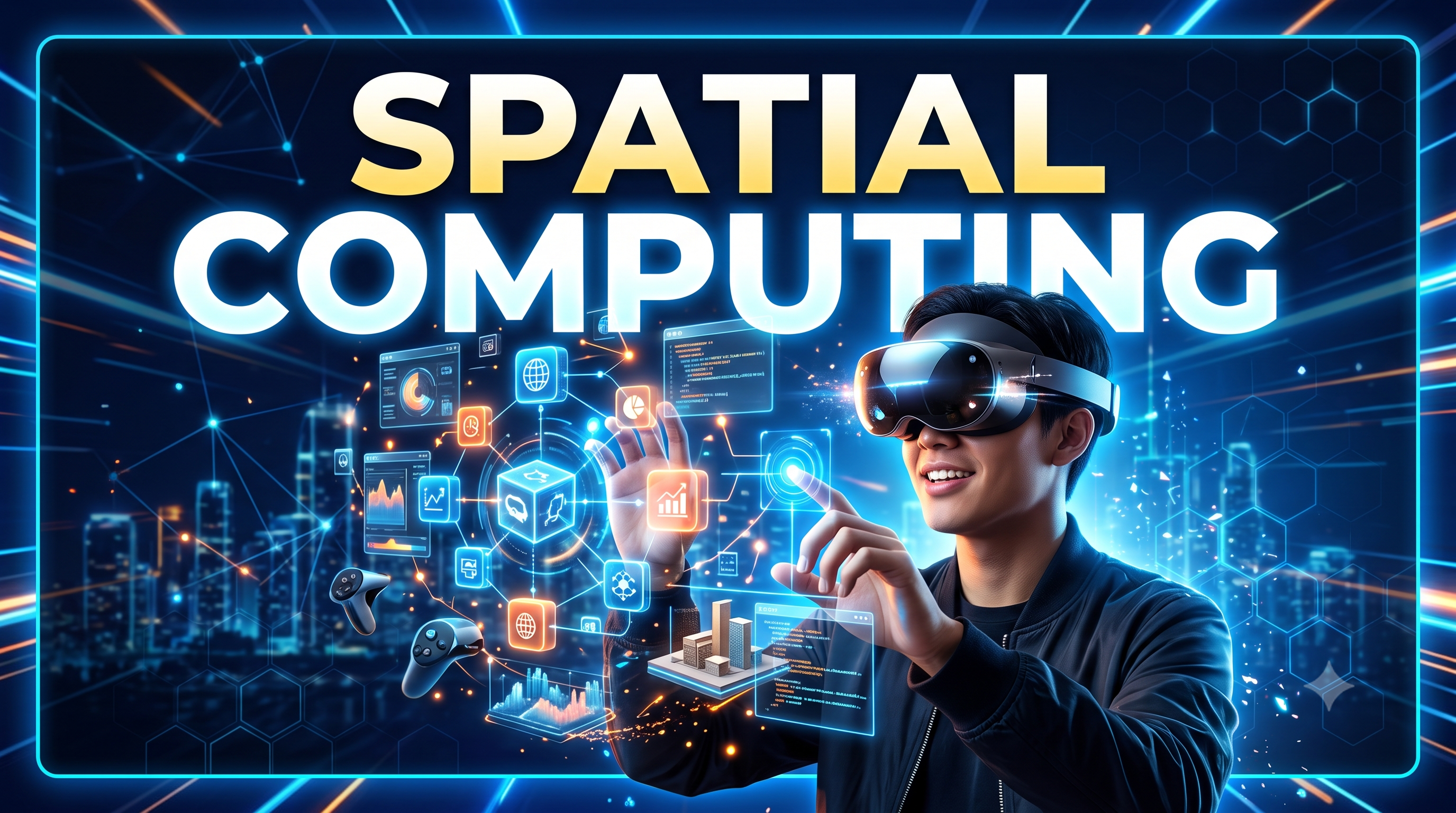
Spatial Computing: Blurring the Lines Between Digital and Physical Worlds
For decades, our primary interaction with digital information has been confined to flat, two-dimensional screens. From desktops to smartphones, our digital lives unfold within a rectangular frame. But what if the digital world could break free, blending seamlessly with our physical surroundings? Enter spatial computing, a revolutionary paradigm that promises to transform how we perceive and interact with technology.
What Exactly is Spatial Computing?
At its core, spatial computing is about placing digital content and experiences within the physical world, allowing users to interact with them in a natural, intuitive way. Unlike traditional virtual reality (VR) which fully immerses you in a simulated environment, or augmented reality (AR) which overlays digital elements onto your view, spatial computing encompasses a broader vision. It's about designing systems that understand and respond to the physical space around the user, enabling digital objects to behave as if they are truly part of that environment.
Think beyond a simple overlay. Imagine:
- A virtual monitor extending your workspace, floating right next to your physical desk.
- Interactive 3D models of products appearing on your living room table for inspection.
- Step-by-step repair instructions visually projected onto a real engine as you work on it.
Interaction in spatial computing often involves natural gestures, eye tracking, and voice commands, moving away from mice, keyboards, and touchscreens.
The Technologies Powering This Shift
Realizing spatial computing requires a convergence of several advanced technologies:
- Advanced Sensors: Cameras, depth sensors (LiDAR), and motion trackers constantly scan and map the environment, understanding its geometry and identifying objects.
- Powerful Processors: High-performance chips are needed to render complex 3D graphics in real-time and process vast amounts of sensor data with minimal latency.
- Sophisticated AI and Computer Vision: These enable devices to recognize objects, track user movements, understand intent, and anchor digital content realistically within the physical space.
- Immersive Displays: Devices like mixed reality headsets (e.g., Apple Vision Pro, Meta Quest series) provide the visual interface, blending digital images with the real world or creating fully immersive virtual environments.
- Spatial Audio: Audio that appears to emanate from specific points in the physical space, enhancing immersion and realism.
Transforming Industries and Daily Life
The implications of spatial computing are vast, promising to revolutionize numerous sectors:
- Work and Collaboration: Remote teams can collaborate in shared virtual spaces, manipulating 3D models or reviewing documents as if they were in the same room. Designers can prototype and iterate on products in a true-to-life scale.
- Education and Training: Students can explore historical sites or complex anatomical structures in 3D. Surgeons can practice intricate procedures on virtual patients before operating on real ones.
- Entertainment: Gaming becomes truly immersive, with digital characters interacting with your furniture. Movies and concerts can be experienced from impossible angles, right in your living room.
- Retail: Customers can virtually try on clothes, place furniture in their homes, or examine products with unprecedented detail before making a purchase.
- Healthcare: Doctors can visualize patient data in 3D during surgery, or provide remote assistance to paramedics with overlaid instructions.
Challenges on the Horizon
While the potential is immense, spatial computing faces several hurdles:
- Cost and Accessibility: Current high-end devices are expensive, limiting widespread adoption.
- Comfort and Ergonomics: Wearing headsets for extended periods can be uncomfortable, and battery life is a constant challenge.
- Privacy and Security: Devices constantly mapping environments raise significant concerns about data collection and user privacy.
- Developer Ecosystem: Building compelling spatial experiences requires new tools, skills, and design philosophies, which are still evolving.
- Digital Divide: Ensuring equitable access and avoiding the creation of new divides will be crucial.
Key Takeaways
Spatial computing is more than just a technological advancement; it's a fundamental shift in how we interact with information and the world around us. By dissolving the boundaries between the digital and physical, it opens up a universe of possibilities for work, play, education, and social connection. While challenges remain, the foundational technologies are maturing rapidly, hinting at a future where our digital experiences are no longer confined to screens but are woven directly into the fabric of our reality. The journey has just begun, and the coming years promise exhilarating innovations in this exciting new frontier.
Be the first to leave a comment.
Leave a comment