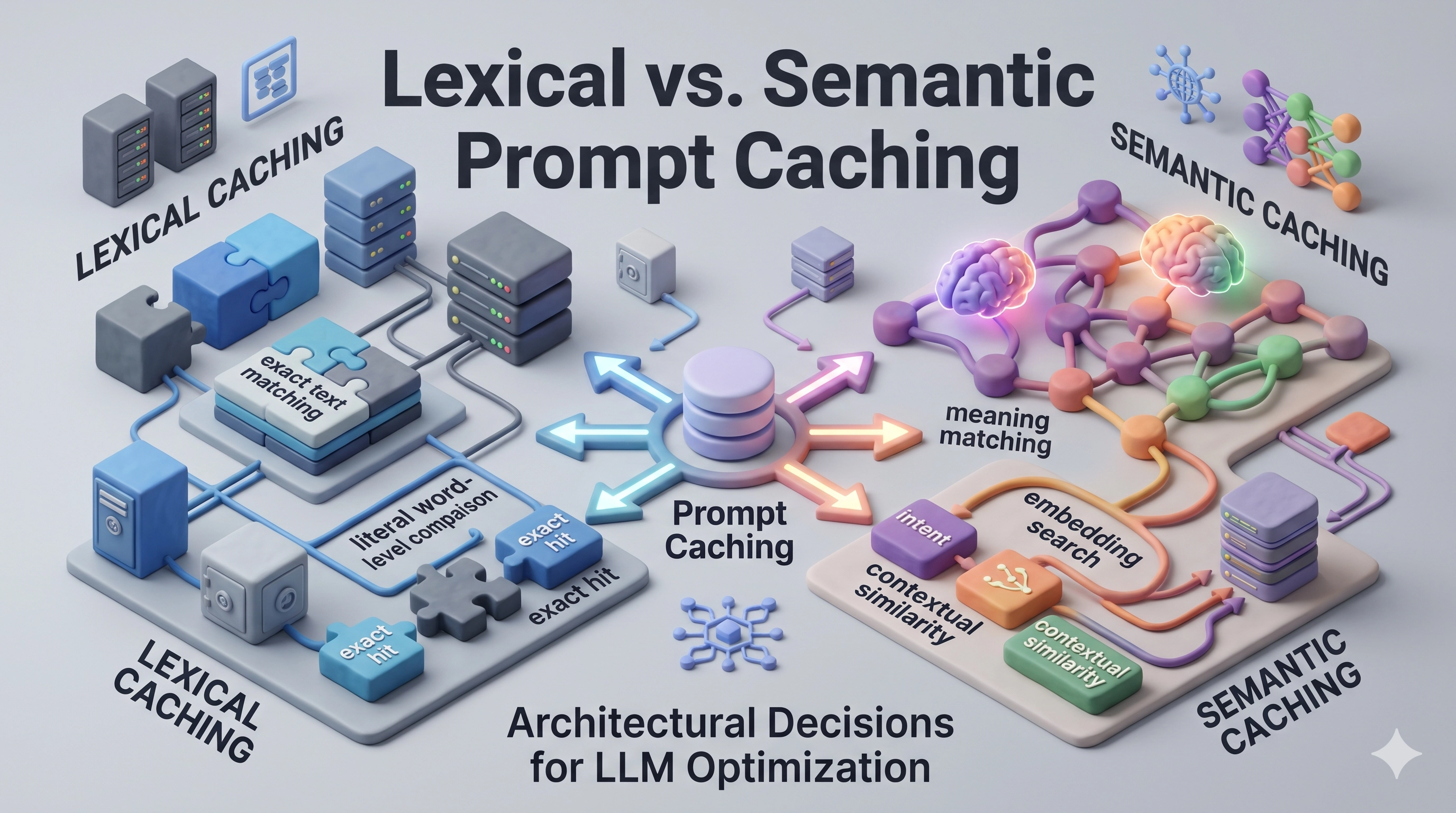
Lexical vs. Semantic Prompt Caching: Architectural Decisions for LLM Optimization
In the rapidly evolving landscape of Large Language Models (LLMs), optimizing both cost and latency is paramount for any production-grade application. Every API call to an LLM provider or inference on a self-hosted model incurs computational expense and contributes to response time. One of the most effective strategies to mitigate these factors is prompt caching.
While many LLM frameworks and even the models themselves implement internal caching mechanisms (like KV cache prefix sharing), this post focuses on application-level prompt caching strategies. We'll compare two distinct architectural patterns: Lexical Prompt Caching (LPC) and Semantic Prompt Caching (SPC). Understanding their mechanics, trade-offs, and ideal use cases is crucial for building efficient and scalable LLM-powered applications.
Lexical Prompt Caching (LPC): The Exact Match Strategy
Lexical Prompt Caching, at its core, is a straightforward key-value caching mechanism. The "key" is the exact string content of the user's prompt (or a normalized version thereof), and the "value" is the corresponding LLM response. When a new prompt comes in, the system first checks if an identical prompt exists in the cache. If found, the cached response is immediately returned, bypassing the LLM inference step entirely.
Mechanism:
- Normalize the incoming prompt (e.g., trim whitespace, lower-case).
- Use the normalized prompt as a key to query a cache store (e.g., Redis, Memcached, a simple in-memory hash map).
- If a hit occurs, return the cached LLM response.
- If a miss, call the LLM, receive the response, store the prompt-response pair in the cache, and then return the response.
Pros:
- Simplicity: Easy to implement with standard caching technologies.
- Speed: Lookups are extremely fast, typically O(1) or O(log N) depending on the cache backend.
- Predictable Savings: Guarantees cost and latency reduction for identical, repeated prompts.
Cons:
- Brittleness: Even a single character change (e.g., a typo, different punctuation) will result in a cache miss.
- Limited Scope: Only effective for strictly repetitive queries. Less useful for conversational AI or varied user inputs.
- Low Hit Rate: For many applications, the probability of an exact prompt repeat is low, leading to a diminished cache hit rate.
Example Implementation (Conceptual Python):
import redis

def get_llm_response_lpc(prompt: str, llm_api_call_func, cache_client: redis.Redis):
    normalized_prompt = prompt.strip().lower() # Simple normalization
    cached_response = cache_client.get(normalized_prompt)

    if cached_response:
        print("LPC Cache Hit!")
        return cached_response.decode('utf-8')
    else:
        print("LPC Cache Miss. Calling LLM...")
        llm_response = llm_api_call_func(prompt)
        cache_client.set(normalized_prompt, llm_response, ex=3600) # Cache for 1 hour
        return llm_response
Semantic Prompt Caching (SPC): The "Meaning-Based" Strategy
Semantic Prompt Caching takes a more sophisticated approach, leveraging the power of vector embeddings. Instead of caching prompts based on their exact string form, SPC caches them based on their meaning or semantic similarity. When a prompt arrives, it's converted into a vector embedding, and then a similarity search is performed against a vector database of previously embedded and cached prompts. If a sufficiently similar prompt is found (above a defined similarity threshold), its corresponding response is returned.
Mechanism:
- Convert the incoming prompt into a high-dimensional vector embedding using an embedding model (e.g., OpenAI's
text-embedding-ada-002, Sentence Transformers). - Perform a similarity search (e.g., cosine similarity) in a vector database containing embeddings of previously cached prompts.
- If a similar prompt's embedding is found above a certain similarity threshold, return its associated LLM response.
- If no sufficiently similar prompt is found, call the LLM, get the response, embed the new prompt, store both the new embedding and its response in the vector database, and then return the response.
Pros:
- Robustness: Tolerant to minor variations, typos, rephrasing, and synonyms.
- Higher Hit Rate: Can achieve significantly higher cache hit rates, especially in conversational or varied input scenarios.
- Broader Applicability: More suitable for complex LLM applications where exact repeats are rare but semantically similar queries are common.
Cons:
- Complexity: Requires an embedding model and a vector database, adding architectural overhead and operational complexity.
- Latency Overhead: Embedding generation and vector similarity search add latency, which might negate some benefits if not managed well.
- Threshold Tuning: Defining the "sufficiently similar" threshold is critical and often requires careful tuning to balance relevance and hit rate.
- Potential Irrelevance: If the threshold is too low, the cached response might be semantically similar but not precisely relevant, leading to subtle quality degradation.
Example Implementation (Conceptual Python):
from qdrant_client import QdrantClient
from qdrant_client.models import PointStruct, VectorParams, Distance
import openai # or other embedding model library
import uuid # For generating unique IDs

# Assume qdrant_client is initialized and collection exists
# Assume get_embedding_func wraps openai.embeddings.create (or similar)

def get_llm_response_spc(prompt: str, llm_api_call_func, embed_model_func, vector_db_client: QdrantClient, collection_name: str, similarity_threshold: float = 0.85):
    query_embedding = embed_model_func(prompt)

    search_result = vector_db_client.search(
        collection_name=collection_name,
        query_vector=query_embedding,
        limit=1
    )

    if search_result and search_result[0].score >= similarity_threshold:
        print("SPC Cache Hit!")
        # Assuming payload stores the original prompt and response
        return search_result[0].payload["llm_response"]
    else:
        print("SPC Cache Miss. Calling LLM...")
        llm_response = llm_api_call_func(prompt)

        # Store new prompt, embedding, and response in vector DB
        point = PointStruct(
            id=str(uuid.uuid4()), # Generate unique ID
            vector=query_embedding,
            payload={"original_prompt": prompt, "llm_response": llm_response}
        )
        vector_db_client.upsert(
            collection_name=collection_name,
            points=[point]
        )
        return llm_response
Note: The Qdrant client example is simplified. In a real-world scenario, you'd manage collection creation, vector dimensions, and more robust payload structures.
Architectural Trade-offs & Decision Guide
Choosing between LPC and SPC (or a hybrid approach) depends heavily on your application's requirements, traffic patterns, and tolerance for complexity.
1. Cost Profile:
- LPC: Minimal computational cost beyond basic string operations. Storage cost for keys/values is generally low.
- SPC: Incurs costs for embedding model API calls (if external) or inference (if self-hosted), and vector database operations/storage. These can be substantial.
2. Latency Characteristics:
- LPC: Near-instantaneous cache lookups.
- SPC: Adds latency for embedding generation and vector similarity search. This overhead might be acceptable for complex prompts but could be a bottleneck for very fast applications.
3. Implementation & Operational Complexity:
- LPC: Low complexity. A single Redis instance or even an in-memory cache is often sufficient.
- SPC: High complexity. Requires managing an embedding model (API key, rate limits, or deployment) and a vector database (scaling, indexing, maintenance).
4. Cache Hit Rate & Robustness:
- LPC: Low to moderate hit rate, very brittle. Best for highly repetitive, identical queries.
- SPC: Potentially high hit rate, very robust to variations. Ideal for applications with varied, but semantically similar, user inputs.
When to Choose Which:
- Choose LPC if:
- Your application primarily handles highly repetitive, near-identical prompts (e.g., specific commands, structured queries, internal system prompts).
- You prioritize extremely low latency and minimal operational overhead.
- Cost savings from exact matches are significant enough for your use case.
- Choose SPC if:
- Your application involves natural language understanding, conversational AI, or user queries with significant linguistic variation.
- You need to reduce costs and latency even for semantically similar, but not identical, prompts.
- You have the engineering resources to manage additional infrastructure (embedding models, vector databases).
- You can tolerate a slight increase in latency for cache lookups due to embedding generation and vector search.
- Consider a Hybrid Approach:
- First attempt an LPC lookup. If a miss, then perform an SPC lookup.
- This strategy combines the speed of LPC for exact matches with the robustness of SPC for semantic similarity, offering a balanced approach.
Production Lessons & Failure Modes
Deploying prompt caching effectively requires careful consideration of several factors:
- Cache Invalidation: LLMs are constantly evolving, and their responses might change over time, making cached data stale. Implement robust TTL (Time-To-Live) policies or manual invalidation mechanisms.
- Context Window Management: For long conversational contexts, caching full exchanges can be complex. Consider caching individual turns or summarized contexts.
- Sensitivity & Privacy: Be cautious about caching prompts or responses containing sensitive user data. Implement proper anonymization or avoid caching such interactions.
- Monitoring: Track cache hit rates, latency, and cost savings for both LPC and SPC to understand their real-world impact and fine-tune parameters.
- Embedding Model Drift (for SPC): If you update your embedding model, existing cached embeddings might become incompatible or less effective, potentially requiring a cache rebuild.
Key Takeaways
- Lexical Prompt Caching is simple, fast, and cost-effective for exact prompt repeats, offering predictable savings but lacking robustness to variations.
- Semantic Prompt Caching is more complex and adds latency, but provides superior hit rates and robustness for natural language queries by leveraging vector similarity.
- The choice depends on your application's specific prompt patterns, performance requirements, and engineering resources. A hybrid strategy often offers the best of both worlds.
Be the first to leave a comment.
Leave a comment