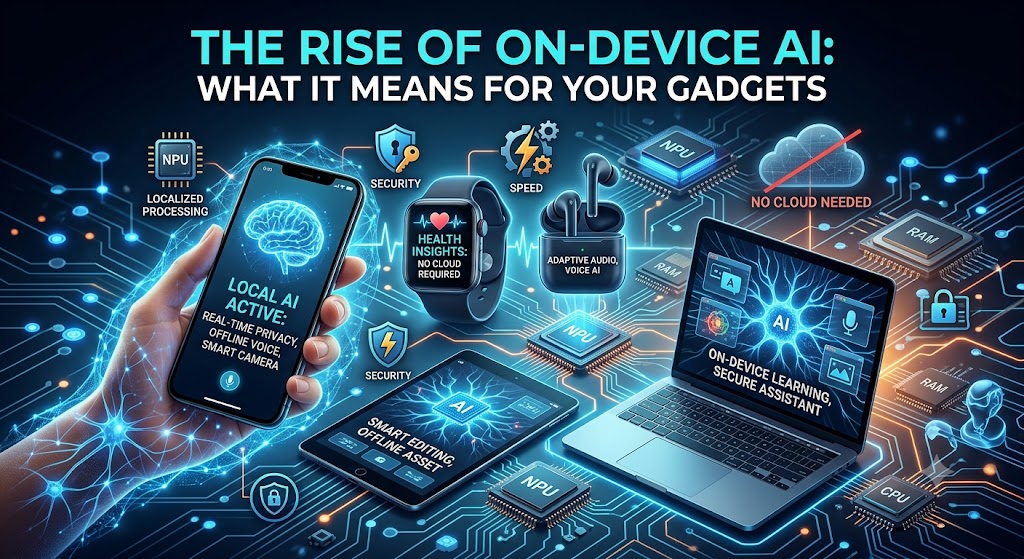
The Rise of On-Device AI: What it Means for Your Gadgets
For years, when we talked about Artificial Intelligence, we often envisioned powerful data centers crunching numbers in the cloud. However, a significant shift is underway: AI is increasingly moving out of the cloud and directly onto the devices we use every day – our smartphones, laptops, smartwatches, and even home appliances. This trend, known as On-Device AI or Edge AI, is quietly revolutionizing how our gadgets operate. But what exactly does it mean for you?
What is On-Device AI?
Simply put, On-Device AI refers to AI models and algorithms that run directly on your local device's hardware, rather than sending data to a remote server for processing. Instead of your phone uploading a photo to the cloud for AI analysis, the phone itself performs the analysis using its built-in processor and specialized AI chips (like Apple's Neural Engine or Qualcomm's AI Engine).
Why the Shift? The Benefits of Local Processing
The move towards On-Device AI isn't just a technical curiosity; it offers several compelling advantages that directly impact your daily experience:
Enhanced Privacy: Perhaps the most significant benefit. When AI processing happens on your device, your sensitive data (like photos, voice recordings, or personal health metrics) never leaves it. This drastically reduces the risk of data breaches and gives you more control over your information.
Faster Performance & Reduced Latency: No need to send data over the internet and wait for a response from a distant server. Local processing means immediate results. Think instant photo recognition, real-time voice command execution, or quicker predictive text suggestions.
Offline Capability: AI features can work even without an internet connection. This is invaluable for remote areas, during travel, or when connectivity is spotty.
Lower Cloud Costs: For companies, processing data locally reduces the need for massive cloud infrastructure, potentially lowering operational costs. While this is more of a developer/business benefit, it contributes to the broader adoption of the technology, ultimately benefiting consumers through more capable devices.
Improved Efficiency: By intelligently offloading certain tasks to dedicated local hardware, overall system power consumption can sometimes be optimized compared to constantly streaming data to and from the cloud.
Where You're Already Seeing On-Device AI in Action
You might be surprised to learn that you're probably already using On-Device AI without even realizing it:
Smartphones: Advanced camera features (scene detection, portrait mode enhancements, object recognition), face unlock, voice assistants (processing simple commands offline), predictive text and autocorrection, and even battery optimization.
Smart Home Devices: Some smart speakers and security cameras perform initial voice command processing or motion detection locally before deciding whether to send data to the cloud.
Wearables: Fitness trackers and smartwatches use on-device AI for more accurate activity recognition, heart rate zone monitoring, and sleep pattern analysis, often without constant cloud sync.
Laptops: Features like background blur in video calls, noise cancellation, and intelligent power management increasingly leverage local AI capabilities.
The Future is Local: What's Next?
As dedicated AI chips become more powerful and efficient, and AI models become more optimized for smaller footprints, we can expect On-Device AI to become even more ubiquitous and sophisticated. Imagine your car anticipating traffic patterns based on your local driving habits, your health device detecting subtle changes in your well-being with greater accuracy, or your smart home proactively adjusting to your routines without constant internet reliance. The future of AI is not just in the cloud; a significant part of it is right there in your hand, on your desk, or in your home.
Key Takeaways
On-Device AI brings powerful AI capabilities directly to your gadgets.
Key benefits include enhanced privacy, faster performance, and offline functionality.
You're likely already using On-Device AI in your smartphones, wearables, and smart home devices.
This trend promises a future of smarter, more private, and more efficient personal technology.
Be the first to leave a comment.
Leave a comment