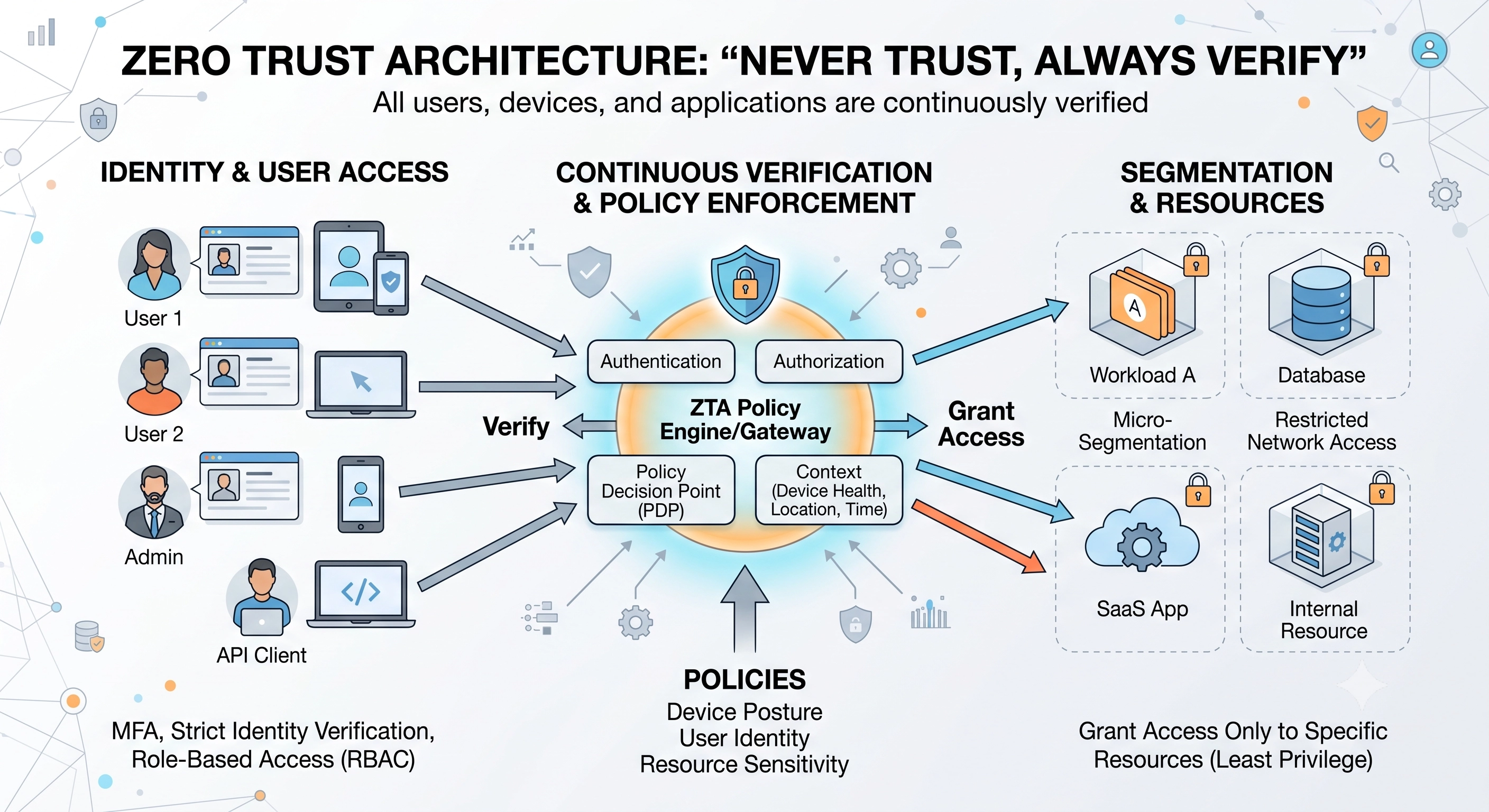
Zero Trust Architecture: Rethinking Digital Security
In the digital landscape of today, where work happens everywhere and data resides in various cloud environments, the traditional network security model is increasingly insufficient. For decades, the approach was simple: build a strong perimeter, protect the inside, and trust everything within. This concept, often called the "castle-and-moat" defense, assumes that once an entity is inside the network, it can be trusted. But what happens when the attackers are already inside, or when there's no clear "inside" anymore? Enter Zero Trust Architecture.
What is Zero Trust?
At its core, Zero Trust is a security framework that dictates that no user or device, whether inside or outside an organization's network, should be automatically trusted. Instead, every access request must be verified before granting access. This philosophy is encapsulated in the mantra: "Never trust, always verify."
The traditional model failed because it assumed internal users and devices were inherently trustworthy. Modern threats, such as sophisticated phishing attacks, insider threats, and compromised credentials, can bypass a perimeter defense and then move laterally unchecked within the network. Zero Trust addresses this by treating every access attempt as if it originated from an untrusted network.
Core Principles of Zero Trust
While specific implementations can vary, the foundational principles of a Zero Trust Architecture remain consistent:
- Verify Explicitly: Always authenticate and authorize based on all available data points, including user identity, location, device health, service or workload, data classification, and anomalous behavior.
- Use Least Privilege Access: Limit user access to only the resources absolutely necessary for their role and for the shortest possible duration. This minimizes the "blast radius" if an account is compromised.
- Assume Breach: Design security with the assumption that a breach is inevitable or has already occurred. This means continuously monitoring for threats and ensuring rapid detection and response capabilities.
Key Pillars of Implementation
Achieving a Zero Trust state involves several interconnected components:
Identity Verification: Robust multi-factor authentication (MFA) is paramount. Users are verified not just by a username and password, but by multiple factors (something they know, something they have, something they are).
Device Validation: Devices connecting to the network must be continuously assessed for security posture, patch levels, compliance, and potential compromises. Unhealthy devices are denied access or quarantined.
Micro-segmentation: Networks are divided into smaller, isolated segments. This prevents attackers from moving freely across the entire network if they gain access to one part. Each segment requires separate authorization.
Least Privilege Access: Granting users and applications only the minimum necessary permissions to perform their tasks. This is often dynamic, adjusting based on context and risk.
Continuous Monitoring & Analytics: Real-time logging and analysis of all network traffic, user behavior, and system activity to detect anomalies and potential threats. Automation plays a crucial role here.
Data Protection: Classifying sensitive data and applying strong encryption, access controls, and data loss prevention (DLP) policies, regardless of where the data resides.
Benefits of Zero Trust
Embracing Zero Trust brings significant advantages to organizations:
- Enhanced Security Posture: Significantly reduces the risk of successful breaches and limits lateral movement of attackers.
- Improved Compliance: Helps meet regulatory requirements by enforcing strict access controls and audit trails.
- Better Support for Remote Work: Securely extends access to resources for remote employees and partners without relying on traditional VPNs as the sole security gateway.
- Greater Agility: Enables organizations to leverage cloud services and adopt new technologies more securely.
Challenges and Considerations
Implementing Zero Trust is not a simple flip of a switch. It requires a significant investment in technology, processes, and a cultural shift within the organization. Challenges include:
- Complexity of integration with existing legacy systems.
- Initial user friction due to more stringent authentication requirements.
- The need for skilled personnel to design, implement, and manage the architecture.
- Ongoing effort for continuous monitoring and policy refinement.
Key Takeaways
Zero Trust Architecture represents a fundamental paradigm shift in cybersecurity, moving away from implicit trust to explicit, continuous verification. By assuming breach, verifying every access request, and applying least privilege, organizations can build a more resilient and adaptable security posture for the modern, distributed IT environment. It's not just a product, but a strategic approach to safeguarding digital assets in an ever-evolving threat landscape.
Be the first to leave a comment.
Leave a comment