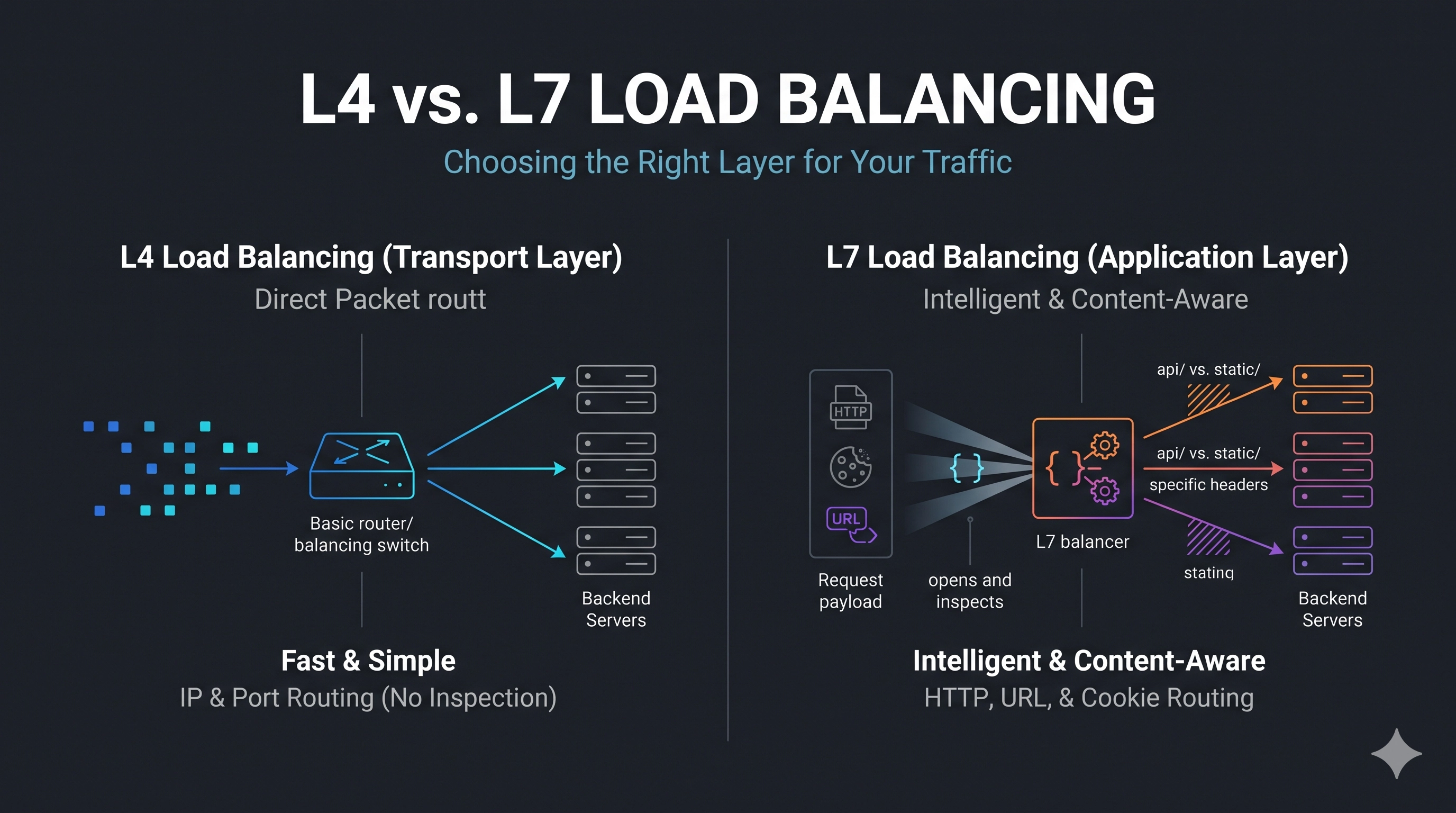
Distributing incoming network traffic across multiple backend servers is a cornerstone of modern scalable and resilient architectures. Without it, a single server becomes a bottleneck and a single point of failure. But the world of load balancing isn't a one-size-fits-all solution; architects frequently face a critical decision: whether to implement load balancing at Layer 4 (Transport Layer) or Layer 7 (Application Layer) of the OSI model. Each approach offers distinct advantages and trade-offs in terms of performance, intelligence, and operational complexity.
Choosing between L4 and L7 isn't just a technical preference; it dictates how granularly you can manage traffic, how efficiently you use your backend resources, and how resilient your services are to various failure modes. Let's break down the mechanics, pros, cons, and a decision framework to guide your next architectural choice.
The Core Distinction: What Each Layer Sees
The fundamental difference lies in the information available to the load balancer at each layer:
- Layer 4 (Transport Layer): Operates on network-level information like IP addresses and port numbers. It sees TCP segments or UDP datagrams but doesn't inspect the content of the packets beyond this.
- Layer 7 (Application Layer): Operates on application-level information, such as HTTP headers, URL paths, cookies, and even the content of the request body. This allows for much more sophisticated routing decisions.
L4 Load Balancing: Fast, Simple, Transparent
L4 load balancers typically work as a network proxy. When a client connects, the L4 balancer establishes a TCP connection (or handles UDP traffic) to an available backend server and then forwards subsequent packets for that connection to the chosen server. It's often referred to as a "stateless" balancer in the sense that it doesn't process application-level data, though it maintains connection state to ensure all packets of a single TCP connection go to the same backend.
Pros:
- High Performance & Low Latency: Because they only inspect IP addresses and ports, L4 balancers can process traffic extremely quickly with minimal overhead. This makes them ideal for high-throughput, low-latency applications.
- Simplicity & Efficiency: Less processing means less CPU and memory consumption. They are simpler to configure and operate, making them cost-effective.
- Protocol Agnostic: Can balance any TCP or UDP traffic, not just HTTP. Great for databases, gaming servers, or custom protocols.
- Full Client-Server Transparency: The backend server often sees the client's original IP address (though sometimes via a proxy protocol if NAT is involved).
Cons:
- Lack of Application Awareness: Cannot inspect HTTP headers, URL paths, or cookies. This limits intelligent routing capabilities.
- Basic Health Checks: Typically only checks if a port is open or a basic TCP handshake is successful. It cannot determine if the application itself is responsive or returning errors.
- No SSL Termination/Offloading: Cannot decrypt SSL/TLS traffic, meaning encryption must be handled by the backend servers, increasing their CPU load.
When to Choose L4:
L4 load balancing is a strong choice for:
- Non-HTTP/HTTPS traffic (e.g., DNS, SMTP, custom TCP services, gaming).
- Situations where maximum raw performance and minimal latency are paramount.
- When backend servers are homogenous and don't require specific content-based routing.
- UDP-based services.
# Example: Using ipvsadm for basic L4 TCP load balancing (Linux)
# Add a virtual server for TCP port 80
sudo ipvsadm -A -t 192.168.1.100:80 -s rr

# Add real servers to the virtual server
sudo ipvsadm -a -t 192.168.1.100:80 -r 10.0.0.1:80 -g
sudo ipvsadm -a -t 192.168.1.100:80 -r 10.0.0.2:80 -g
L7 Load Balancing: Intelligent, Flexible, Feature-Rich
L7 load balancers act as a full proxy. They terminate the client connection, inspect the application-layer content (like HTTP headers or body), make a routing decision, and then open a new connection to the selected backend server. This allows for a wealth of advanced features.
Pros:
- Advanced Routing Capabilities: Route traffic based on URL path, HTTP headers (e.g.,
User-Agent,Host), cookies, geographic location, or even request content. Essential for microservices architectures. - SSL/TLS Termination & Offloading: Can decrypt incoming SSL/TLS traffic, taking the cryptographic load off backend servers. This simplifies certificate management and improves backend performance.
- Application-Aware Health Checks: Can send actual HTTP requests (e.g., to an
/healthzendpoint) and check response codes to verify application health, not just server availability. - Content Modification & Optimization: Can perform URL rewriting, HTTP header manipulation, compression, and caching at the load balancer level.
- Web Application Firewall (WAF) Integration: Many L7 balancers include WAF capabilities or integrate with external WAFs for enhanced security.
- Sticky Sessions: Can maintain "sticky sessions" where a client is always routed to the same backend server, crucial for stateful applications.
Cons:
- Higher Latency & Overhead: Deep packet inspection and connection termination/re-establishment introduce more latency and consume more CPU/memory.
- Increased Complexity: Configuration can be more intricate due to the vast array of routing rules and features.
- Protocol Specific: Primarily designed for HTTP/HTTPS, although some can handle other L7 protocols.
- Resource Intensive: Requires more robust hardware or cloud instances due to the processing load.
When to Choose L7:
L7 load balancing is indispensable for:
- Modern web applications and APIs, especially microservices.
- Environments requiring advanced security features (WAF, rate limiting).
- When SSL/TLS offloading is beneficial for backend server performance.
- A/B testing, blue/green deployments, or canary releases based on request attributes.
- Content-based routing (e.g., routing
/api/usersto one service and/app/docsto another).
# Example: Basic Nginx L7 HTTP Load Balancing
http {
    upstream backend_servers {
        server 10.0.0.1:8080;
        server 10.0.0.2:8080;
    }

    server {
        listen 80;
        server_name example.com;

        location / {
            proxy_pass http://backend_servers;
            proxy_set_header Host $host;
            proxy_set_header X-Real-IP $remote_addr;
            proxy_set_header X-Forwarded-For $proxy_add_x_forwarded_for;
        }

        location /api/v1/users {
            proxy_pass http://users_service; # Route to a different upstream
        }
    }

    upstream users_service {
        server 10.0.1.1:3000;
    }
}
Operational Complexity and Scaling Limits
From an operational standpoint, L4 balancers are generally simpler to manage. Their stateless nature (at the application layer) means scaling them horizontally is often straightforward. They tend to be highly stable as they do less processing.
L7 balancers, due to their rich feature set and connection termination, can be more complex to configure, troubleshoot, and scale. Resource contention (CPU, memory) is more likely under heavy load, requiring careful sizing and monitoring. However, their ability to intelligently route traffic can simplify backend service management, especially in microservices where different services might handle different parts of a request.
Many modern cloud load balancers offer both L4 (e.g., Network Load Balancer in AWS, External TCP/UDP Load Balancing in GCP) and L7 (e.g., Application Load Balancer in AWS, External HTTP(S) Load Balancing in GCP) options, allowing you to choose based on your specific needs.
Key Takeaways
- L4: Prioritizes raw speed, low overhead, and protocol agnosticism. Ideal for simple TCP/UDP services where content inspection is not required.
- L7: Offers intelligent traffic management, SSL offloading, advanced security, and content modification. Indispensable for modern web applications, APIs, and microservices.
- Decision Point: If your application needs advanced routing, security, or performance optimizations at the HTTP layer, L7 is your go-to. If you need maximum throughput for non-HTTP traffic or simple services, L4 is often sufficient and more efficient.
- Hybrid Approaches: It's common to see L4 balancers distributing traffic to a cluster of L7 balancers, which then distribute to application servers. This combines the raw speed of L4 with the intelligence of L7.
Be the first to leave a comment.
Leave a comment