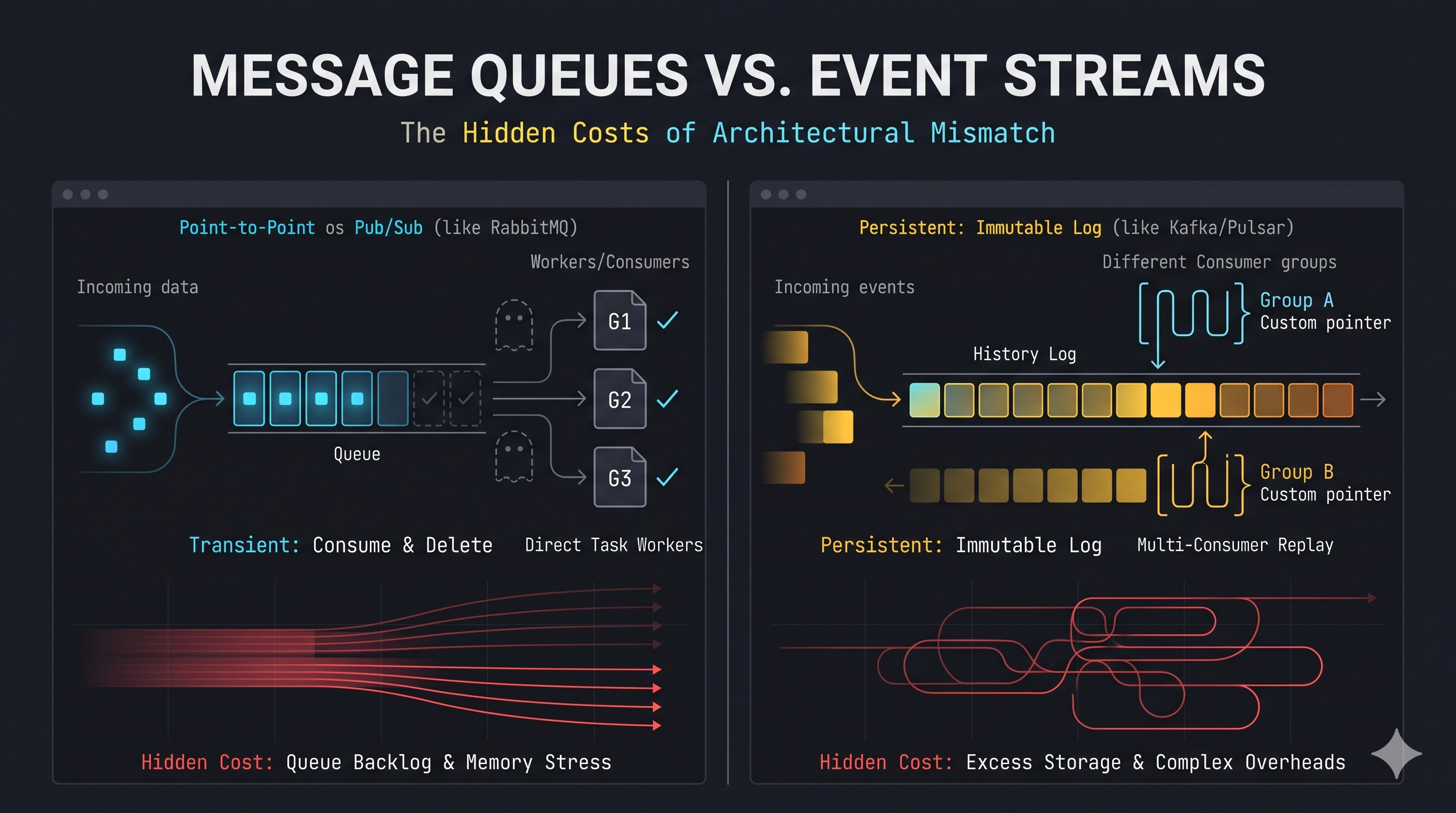
Developers often find themselves needing to send data between services asynchronously. This immediately brings message brokers to mind. But while terms like "message queue" and "event stream" are sometimes used interchangeably, the underlying architectures of systems like RabbitMQ and Apache Kafka are profoundly different. Treating them as mere synonyms is a common pitfall that leads to subtle but agonizing production issues: missed messages, complex replays, unexpected latency spikes, or an inability to scale certain patterns.
This post will dive into these core distinctions, highlighting how an architectural mismatch – choosing the wrong tool for the job – can manifest as painful bugs and performance bottlenecks in your backend systems.
Understanding the Core Distinctions
At a high level, both message queues and event streams facilitate asynchronous communication. However, their fundamental semantics, data retention models, and scaling patterns diverge significantly.
Message Queues (e.g., RabbitMQ)
Message queues are designed for point-to-point communication and transient task distribution. Think of them as a to-do list where tasks are picked up by workers.
- Semantics: Messages are typically delivered to a single consumer, and once acknowledged, they are removed from the queue. This is a "destructive read" model.
- Architecture: Broker-centric. The broker (like RabbitMQ) is "smart," managing message routing, persistence (until consumed), and delivery guarantees. Consumers are relatively "dumb" – they just receive and process.
- Data Model: Transient messages. Messages have a limited lifespan and are not designed for long-term storage or replay.
- Ordering: Generally FIFO (First-In, First-Out) per queue, but distributing messages across multiple queues or consumers can complicate global ordering.
When RabbitMQ Excels:
- Task Offloading: Asynchronously processing background jobs (e.g., image resizing, email sending).
- Load Leveling: Buffering spikes in requests to smooth out load on backend services.
- Decoupling Services: Allowing services to communicate without direct knowledge of each other, where messages are consumed once.
Example: Simple Task Queue (Node.js/RabbitMQ concept)
// Producer
channel.sendToQueue('image_processing_queue', Buffer.from(imagePath), { persistent: true });

// Consumer
channel.consume('image_processing_queue', async (msg) => {
  if (msg !== null) {
    console.log(`Processing image: ${msg.content.toString()}`);
    await processImage(msg.content.toString());
    channel.ack(msg); // Message removed from queue
  }
}, { noAck: false });
Event Streams (e.g., Apache Kafka)
Event streams are built for publish-subscribe patterns and durable, immutable event logs. Think of them as a continuous, append-only ledger of everything that has happened.
- Semantics: Events are appended to a log and are available to multiple consumers independently. Consumers track their own "offset" (position in the log). Events are retained for a configurable period, not removed upon consumption. This is a "non-destructive read" model.
- Architecture: Distributed log. The broker (Kafka) is relatively "dumb" – it just stores and serves event records. Consumers are "smart," managing their own consumption progress (offsets) and allowing for powerful replay capabilities.
- Data Model: Persistent, immutable events. Events form a historical record that can be replayed from any point.
- Ordering: Guaranteed FIFO within a single partition. Global ordering requires careful design using a single partition or re-ordering at the consumer level.
When Kafka Excels:
- Event Sourcing: Reconstructing application state from a sequence of immutable events.
- Real-time Analytics & Data Pipelines: Processing large volumes of events for dashboards, monitoring, or feeding data lakes.
- Change Data Capture (CDC): Capturing database changes as a stream of events.
- Broadcasting Events: Reliably sending the same event to multiple, independent services.
Example: Event Stream (Python/Kafka concept)
# Producer
producer.send('user_activity_stream', key=b'user123', value=b'{"action": "login"}')
producer.flush()

# Consumer (in a consumer group)
for message in consumer:
  print(f"Topic: {message.topic}, Partition: {message.partition}, Offset: {message.offset}, Key: {message.key}, Value: {message.value.decode('utf-8')}")
  # Kafka automatically manages consumer offsets for the group
Production Pitfalls: The Cost of Architectural Mismatch
Choosing the wrong messaging system isn't just an academic mistake; it leads to concrete, painful production issues.
Pitfall 1: Trying to Replay Events with a Message Queue
Symptom: A new microservice needs to process all historical user sign-up events, but your current system uses RabbitMQ for user registrations. You realize there's no way to get past events without re-engineering the entire registration flow and re-inserting data.
Root Cause: Message queues inherently delete messages after successful consumption. They are not designed to store a historical log of events. If a new service comes online or an existing service needs to reprocess data, the events are simply gone.
Production-Grade Fix: For event-driven architectures requiring replayability, auditing, or multiple independent consumers of the same event stream, Kafka (or similar event streaming platforms) is the correct choice. It treats events as an immutable log, allowing consumers to start from any offset and reprocess data.
Pitfall 2: Overengineering Simple Task Distribution with an Event Stream
Symptom: You use Kafka for all asynchronous tasks. For simple background jobs like sending a one-off email, you find yourself dealing with Kafka's consumer groups, offset management, and partition keys, which feels overly complex. You might even observe messages staying in the log for longer than needed, consuming disk space.
Root Cause: While Kafka can be used for task queues, its strengths lie in stream processing and durable event logs. For simple "fire-and-forget" or work distribution patterns where a message is consumed once and then discarded, the overhead of Kafka's persistent log and distributed consumer group management can be unnecessary complexity. Furthermore, ensuring strict FIFO for a specific task type across multiple Kafka partitions requires careful keying, which might not be intuitive or straightforward.
Production-Grade Fix: For simple, transient task queues, especially those needing strict FIFO for a specific worker pool and where replayability is not a concern, a dedicated message queue like RabbitMQ is often a simpler, more efficient, and operationally lighter choice.
Pitfall 3: Suboptimal Latency for Point-to-Point Communication
Symptom: Your system requires low-latency, point-to-point command messages (e.g., triggering a specific action on a device). You implement this using Kafka, but despite efforts, end-to-end latency is higher than expected, and you're struggling to guarantee delivery to a single, specific recipient without complex topic design.
Root Cause: Kafka is optimized for high-throughput batching and stream processing, which can introduce micro-latencies as messages are buffered and written to disk before being made available to consumers. While low-latency Kafka deployments are possible, RabbitMQ, with its direct queueing mechanisms and in-memory optimizations (for non-durable messages), can often offer lower latency for specific point-to-point command patterns where immediate consumption by a single handler is paramount. Ensuring single recipient delivery in Kafka requires careful use of consumer groups, partitioning, and potentially individual topics per recipient, adding complexity.
Production-Grade Fix: Evaluate if a true "command bus" pattern (point-to-point, single consumer, often synchronous or near-synchronous acknowledgement) is a better fit for critical low-latency actions. For such cases, a traditional message queue or even a direct RPC call might be more appropriate, or a hybrid approach where Kafka handles the event stream and RabbitMQ handles specific commands.
Key Takeaways
- Message Queues (RabbitMQ): Ideal for transient task distribution, work queues, and scenarios where messages are consumed once and deleted. They offer simpler scaling for specific worker pools and often lower latency for point-to-point commands.
- Event Streams (Kafka): Essential for durable event logs, event sourcing, real-time data pipelines, and broadcasting events to multiple, independent consumers. They provide replayability and are built for high-throughput, fault-tolerant stream processing.
- Choose Wisely: The primary differentiator is whether you need a transient task or an immutable, replayable event. An architectural mismatch leads to increased complexity, performance bottlenecks, and limitations that are hard to resolve post-deployment. Don't force a square peg into a round hole; understand the fundamental philosophy of your messaging system.
Be the first to leave a comment.
Leave a comment